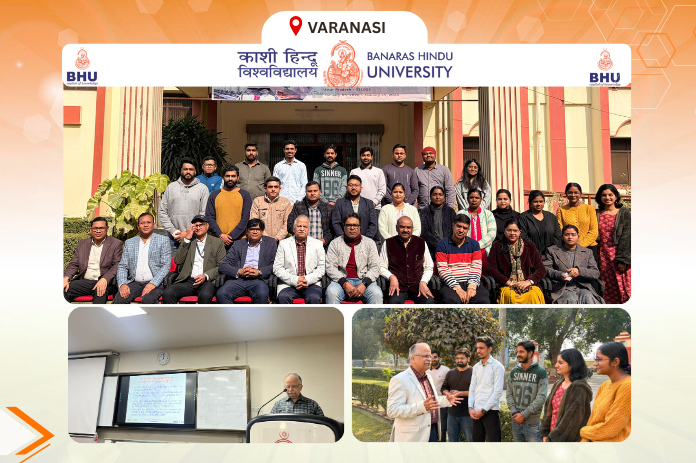
The three-day training on IS/ISO 22000:2018 & IS 15000:2024 was successfully conducted from 21–23 January 2026 at the Banaras Hindu University, Varanasi.
The session focused on strengthening understanding of the Food Safety Management System (FSMS) with reference to Hazard Analysis and Critical Control Point (HACCP) and Internal Audit practices. Organized under the prestigious ICAR-sponsored ICAR-CAFT Programme, the training was part of the Twenty-One Days Advanced Faculty Training Programme on “Functional Dairy Foods: From Concept to Commercialization.” Held at the Centre of Food Science and Technology under the Institute of Agricultural Sciences, the programme brought together faculty members and research scholars from reputed universities and Krishi Vigyan Kendras (KVKs) across India.
A detailed press release covering this three-day Food Safety Management System training programme conducted at BHU, Varanasi, is also available. Click here to read the full press release.
Overview of the IS/ISO 22000:2018 & IS 15000:2024 Training
The training was led by Mr. Ajay Kumar Bhatnagar, CMD, who conducted in-depth sessions on:
The sessions were designed not only to explain compliance requirements but also to help participants understand the real-world application of food safety standards in academic and institutional environments.
Understanding Food Safety Management System (FSMS)
A Food Safety Management System (FSMS) as per IS/ISO 22000:2018 & IS 15000:2024 integrates internationally recognized food safety principles with structured risk management practices. It ensures that food products are safe for consumption at every stage of the supply chain.
Participants gained clarity on how to align institutional food production, research labs, and pilot dairy processing units with national and international food safety requirements.
Hazard Analysis and Critical Control Point (HACCP) as per IS 15000:2024
A major highlight of the programme was the detailed explanation of Hazard Analysis and Critical Control Point (HACCP) principles aligned with IS 15000:2024.
Real-life case studies and structured worksheets were used to simplify complex regulatory concepts. This practical orientation helped faculty members and research scholars understand how to integrate HACCP principles into teaching modules and applied research.
Importance of Internal Audit in FSMS
Another crucial component of the IS/ISO 22000:2018 & IS 15000:2024 framework is the Internal Audit process.
Internal audits ensure:
Participants were guided on conducting systematic internal audits, preparing audit checklists, documenting findings, and implementing corrective actions effectively.
Academic Impact at Banaras Hindu University (BHU), Varanasi
The programme was conducted at Banaras Hindu University, one of India’s most respected educational institutions located in Varanasi.
As part of the ICAR-CAFT Programme, the training created a collaborative academic atmosphere where faculty members and scholars:
The exposure provided during this programme will significantly enhance curriculum development, research practices, and food safety compliance mechanisms across participating institutions.
Participant Feedback and Outcomes
The response to the training was overwhelmingly positive. Participant feedback ratings ranged between 9 and 10 out of 10, reflecting:
The interactive discussions, real-life examples, and worksheet-based exercises ensured that the learning extended beyond theory to practical implementation.
Why IS/ISO 22000:2018 & IS 15000:2024 Training Matters for Academic Institutions
For universities and research institutes involved in food science and dairy technology, compliance with IS/ISO 22000:2018 & IS 15000:2024 is not just a regulatory requirement but a strategic necessity.
Key Benefits Include:
By integrating FSMS and HACCP principles into academic ecosystems, institutions can bridge the gap between theory and industrial practice.
Conclusion: Strengthening Food Safety Through Structured Training
The three-day training on IS/ISO 22000:2018 & IS 15000:2024 under the ICAR-CAFT Programme at BHU, Varanasi, successfully strengthened the understanding of Food Safety Management System (FSMS), HACCP, and Internal Audit practices among faculty members and research scholars.
Such initiatives play a vital role in building food safety leadership within academic institutions and contribute significantly to India’s food processing and dairy sectors.
If your institution is looking to enhance compliance with food safety standards or conduct structured FSMS and HACCP training programmes, now is the right time to invest in expert-led training sessions that deliver practical and measurable outcomes.