a
1 / 1

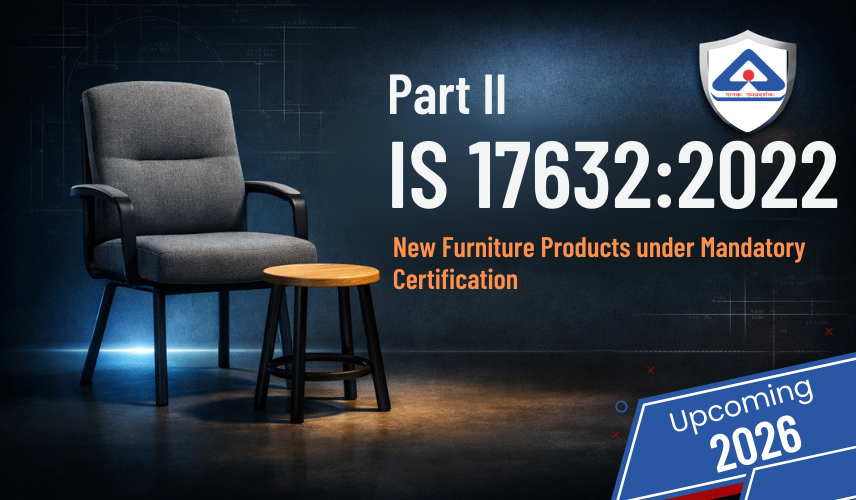
What is BIS Certification for General Purpose Chairs and Stools IS 17632:2022 ?

Think about how often you sit each day at your desk, dining table, or in a waiting room. But what if the chair you are using cannot safely support normal usage conditions? This is where quality and safety standards become critical.

To ensure that general purpose chairs and stools meet essential durability, stability, strength, surface performance, and safety requirements, the Bureau of Indian Standards (BIS) has notified IS 17632:2022. The Furniture (Quality Control) Order, 2025, notified by the Ministry of Commerce & Industry, Department for Promotion of Industry and Internal Trade (DPIIT) on 13 February 2025, mandates compliance with applicable Indian Standards for notified furniture products. The Order shall come into force on 13 February 2026, and any person contravening its provisions shall be punishable under the Bureau of Indian Standards Act, 2016.

This standard helps ensure that furniture placed on the market performs reliably under intended conditions of use.

 BIS certification for furniture products


Scope of IS 17632:2022
IS 17632:2022 specifies the requirements for general purpose chairs and stools.


This standard applies to:

  • Completely manufactured or fabricated general-purpose chairs and stools
  • Ready-to-assemble (knock-down) chairs and stools, where compliance is evaluated after assembly
     

This standard does not apply to:

  • Reclining or tilting chairs
  • Rocking chairs
  • Settees and multiple seating units
  • Work chairs with swivel mechanisms or chair bases fitted with castors, which are covered under other applicable BIS standards
     

Key & Safety Requirements Under IS 17632:2022

IS 17632 defines performance and safety requirements through a structured set of clauses. The key requirements are outlined below in the required order.


1. Durability Requirements (Clause 3.1)

  • Durability tests simulate repeated movements and loading that occur during long-term use
  • Durability is evaluated through:
    • Seat Fatigue Test
    • Back Fatigue Test
    • Arm Rest Durability

Durability testing ensures that furniture remains serviceable throughout its expected life cycle.


2. Stability Requirements (Clause 3.2 and Clause 7.2)

  • Chairs and stools must remain stable during normal use conditions
  • Stability is evaluated through:
    • Forward overbalancing tests
    • Rearwards Overbalancing tests
    • Sideways overbalancing tests
  • These tests verify resistance to tipping and overturning during intended use
     

3. Strength Requirements (Clause 3.3)

  • Strength tests assess the ability of chairs and stools to withstand applied loads and forces
  • The standard includes:
    • Static tests, where loads are applied gradually
    • Impact tests, which evaluate performance under sudden loading conditions
    • Surface Finish tests Test for surfaces of finished furniture to assess the resistance against given external conditions.
  • These tests confirm that the furniture has adequate strength for its intended application

    Learn more About BIS furniture quality control standards

4. Type, Design and Workmanship (Clause 4)

  • Chairs and stools shall be classified by type as specified in the standard
  • The design or model shall be declared by the manufacturer
  • Exposed edges and protruding parts shall be:
    • Free from burrs and sharp edges
    • Rounded or chamfered for safe handling
  • Ends of accessible hollow components shall be closed or capped
  • Movable or adjustable parts shall be designed to avoid injury or inadvertent operation
  • Wooden components shall be free from stains, unless intentionally incorporated as a design feature
     

5. Surface Performance Requirements (Clause 6)

Finished surfaces of chairs and stools are evaluated to ensure resistance to wear and damage. Surface performance tests include assessment of:

  • Resistance to mechanical damage
  • Resistance to marking by cold liquids, oils, and fats
  • Resistance to marking by cold oils and fats.
  • Colour fastness to:
    • Light
    • Rubbing
    • Perspiration
    • Water
  • Abrasion resistance
  • Adhesion of surface coatings and finishes

Performance benchmarks for surface finishes are referenced from IS 17637:2021.


BIS Certification Process for IS 17632

The BIS certification process generally includes:

  1. Submission of application to BIS
  2. Product testing in BIS-recognized laboratories
  3. Evaluation of manufacturing facilities and quality control systems
  4. Grant of BIS licence upon successful compliance

    Complete BIS certification process

Why IS 17632 Matters for Manufacturers

  • Regulatory Alignment: Ensures compliance with Indian quality and safety standards
  • Market Acceptance: Builds trust with institutional and bulk buyers
  • Reduced Risk: Minimizes product rejection and quality disputes
  • Business Opportunities: Supports participation in organized supply chains and tenders
     

Benefits for Consumers

Compliance with IS 17632 helps ensure:

  • Improved safety and stability
  • Longer service life
  • Reduced risk of premature failure
  • Better overall reliability and value
     

How KMA Global Can Help

Understanding and implementing IS 17632 requirements can be technically demanding. KMA Global provides complete support for:

  • BIS certification for chairs and stools
  • Interpretation of IS 17632 requirements
  • Documentation and application support
  • End-to-end compliance management

Our team helps manufacturers navigate the certification process efficiently and improve first-time approval success.


Need BIS certification assistance?

Contact KMA Global today for expert guidance on IS 17632:2022 compliance and bring your compliant furniture to market with confidence.

Official References


Tags: Scheme I    Scheme II