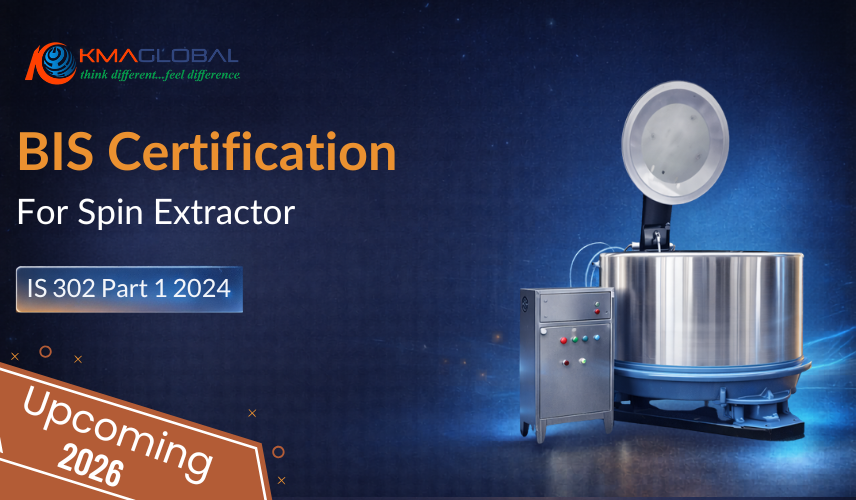
If you've ever used a spin extractor whether at home, in a hotel laundry room, or at a commercial laundromat you already know how useful these machines are.
But here's something worth thinking about behind that spinning drum is a powerful electric motor, rotating mechanical components, and high-speed operation all of which come with real safety risks if the appliance isn't designed and built correctly. Electrical shock, overheating, mechanical instability, vibration-related failure, and injury from moving parts are all genuine hazards that manufacturers need to account for.
That's exactly why the Bureau of Indian Standards (BIS) adopted IS 302 (Part 1): 2024, which is technically identical to IEC 60335-1:2020. These standard lays down the general safety requirements that household and similar-use electrical appliances including spin extractors must meet before they can be placed in the market. If you're a manufacturer, importer, or quality professional working in this space, understanding what this standard demand isn't optional. It's fundamental.
Think of IS 302 (Part 1): 2024 as the foundational safety rulebook for household electrical appliances. It's a general standard, which means it doesn't address spin extractors exclusively instead, it establishes the baseline requirements that apply across a wide range of household electrical products. Appliance-specific Part 2 standards build on top of this foundation.
The standard covers appliances with the following electrical ratings:
Rated voltage up to 250 V for single-phase appliances
Rated voltage up to 480 V for other appliances, including DC-operated units and battery-operated appliances
That scope extends beyond just homes to include shops, light industrial environments, and farms.
It's also worth knowing what the standard explicitly excludes:
IS 302 Part 1 deals with the reasonably foreseeable hazards presented by appliances that are encountered by all persons. However, in general, it does not take into account:
2. prevents them from using the appliance safely without supervision or instruction;
As per IS 302 (Part 1) appliances are classified into the following categories based on their protection against electric shock:
An appliance protected only by basic insulation and without an earth connection.
An appliance with basic insulation and an earthing terminal, but the power cord and plug do not have an earth connection.
An appliance with basic insulation and protective earthing, so exposed metal parts are connected to earth for safety.
An appliance protected by double or reinforced insulation and does not require earthing.
An appliance that operates on safety extra-low voltage (SELV) to protect against electric shock.
Appliances shall be constructed and enclosed so that there is adequate protection against accidental contact with live parts and the requirement applies for all positions of the appliance when it is operated as in normal use and after the removal of detachable parts.
Class II appliances and class II constructions shall be constructed and enclosed so that there is adequate protection against accidental contact with basic insulation and metal parts separated from live parts by basic insulation only.
For battery-operated appliances where the battery circuit has a functional earth connection or a supply connection, it shall only be possible to touch parts within a battery compartment where:
In Class I appliances, Class 0I appliances and Class II appliances, they are separated from live parts by double insulation or reinforced insulation
In Class 0 appliances, they are separated from live parts by basic insulation the battery compartment is of Class III construction
The leakage current of the appliance shall not be excessive and its electric strength shall be adequate. Protective impedance is disconnected from live parts before carrying out the tests. The tests are carried out on the appliance at room temperature and not connected to the supply mains.
Spin extractors are not delicate appliances. They vibrate, they're moved around, and in commercial settings they get handled roughly. The standard recognises this reality.
Appliances shall have adequate mechanical strength and be constructed to withstand such rough handling as may be expected in normal use.
Compliance is checked by applying blows to the appliance in accordance with test Ehb of IEC 60068-2-75, known as the spring hammer test:
This is where spin extractor manufacturers need to pay particularly close attention. These appliances operate in laundry environments exposure to water, moisture, and humid conditions is not an occasional edge case; it's a daily reality.
The standard is clear:
The standard also sets specific requirements for how appliances are physically built and connected.
If the appliance is marked with the first numeral of the IP system or any of the additional letters of the IP system, the relevant requirements of IEC 60529 including its amendments shall be fulfilled.
For stationary appliances, means shall be provided to ensure disconnection from the supply mains. Such means shall be one of the following:
IS 302 (Part 1): 2024 is a demanding standard deliberately so. It was built on the recognition that household electrical appliances, precisely because they are used by non-specialists in unpredictable environments, must meet rigorous and verifiable safety requirements.
For spin extractors specifically, compliance with this standard ensures that the appliance is designed to manage the electrical hazards, thermal risks, moisture exposure, and mechanical stresses that come with high-speed operation.
For manufacturers and importers, though, it's worth seeing compliance as something more than just a regulatory obligation. It represents a genuine commitment to designing appliances that operate reliably, safely, and consistently throughout their service life — for every user, in every environment where the product ends up.
Yes, BIS certification becomes mandatory if spin extractors are notified under relevant Quality Control Orders (QCOs). Compliance with IS 302 ensures that the product meets Indian safety standards before it is introduced into the market.
Spin extractors operate at high speeds and involve electrical components, which can pose several risks. These include electric shock, overheating, excessive vibration, mechanical instability, and potential injury from moving parts if safety measures are not properly implemented.
IS 302 (Part 1): 2024 is the Indian standard for the safety of household and similar electrical appliances, aligned with IEC 60335-1. It is important because it defines essential safety requirements that protect users from electrical, thermal, and mechanical hazards during normal use.
The standard applies to appliances operating at a rated voltage of up to 250V for single-phase systems. For other appliances, including DC-operated and battery-operated units, it covers voltage ratings up to 480V.
IS 302 ensures protection against electric shock by requiring proper insulation, effective earthing in applicable appliance classes, and secure enclosure design. It also mandates that live parts must not be accessible during normal operation or after the removal of detachable parts.
Moisture resistance is crucial because spin extractors are commonly used in wet and humid environments such as laundries. The standard requires appliances to be designed in a way that prevents water ingress, thereby reducing the risk of insulation failure and electrical hazards.
About The Author
Jyoti Chauhan is a dedicated Chemical Engineering Professional, delivering value across Regulatory Compliance, Product Conformity, and BIS certification services, with experience in Quality Assurance and Petrochemical & Polymer Res...Read More
Jun 26, 2026
EPR Registration for End-of-Life Vehicles
Jun 24, 2026
EPR Registration for E-Waste Management in India