Public service organizations operate at the interface between government institutions and citizens. The quality, reliability, and transparency of these services significantly influence public confidence in governance.
However, delivering consistent service across departments, locations, and service channels can be challenging without a structured framework. Differences in processes, lack of defined service standards, and ineffective grievance mechanisms often lead to inefficiencies and dissatisfaction among citizens.
To address these challenges, the Indian Standard IS 15700:2018 Service Quality Management System provides a structured framework for managing and improving service delivery in public service organizations. The standard establishes requirements for a Service Quality Management System (SQMS) that enables organizations to consistently deliver services that meet customer expectations, comply with legal and regulatory requirements, and continuously improve performance.
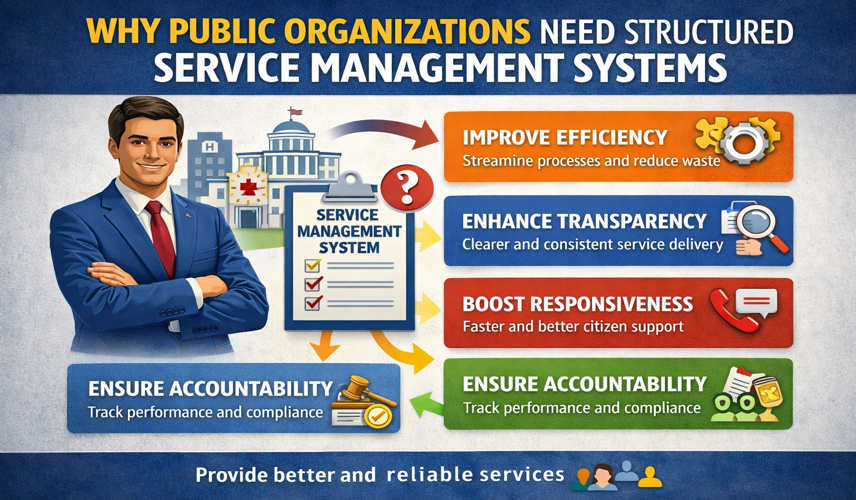
Public organizations provide services that are critical for citizens and businesses. These services must be delivered in a way that is efficient, transparent, and responsive.
A structured service management system helps organizations:
By documenting processes and defining responsibilities, public service organizations can ensure that services are delivered systematically rather than depend on individual discretion.
The framework provided in IS 15700 emphasizes several key elements that collectively strengthen service quality management in public organizations:
One of the central components of the Service Quality Management System is the Citizens’ Charter. It is a formal document that communicates an organization’s commitment to delivering effective and efficient services.
What a Citizens’ Charter Includes
The Charter must be simple, accessible, and widely communicated through websites, public displays, and organizational publications.
The Charter serves as a public declaration of service standards, helping build trust between organizations and citizens.
Effective grievance handling is essential for improving service quality. Complaints provide valuable insights into areas where service delivery may not be meeting expectations.
IS 15700 requires public organizations to establish a structured and documented complaint handling process.
Key Steps in Complaint Handling
Complaints should be viewed as opportunities for improvement rather than negative feedback.
Monitoring and measurement are critical for ensuring that services are delivered according to defined standards.
IS 15700 requires organizations to monitor and measure:
Monitoring must occur at all stages of service delivery, especially at customer interaction points.
Organizations must establish systems for measuring customer satisfaction through feedback collection and service experience analysis.
Benefits of Measuring Customer Satisfaction
This ensures that service improvements are data-driven rather than assumption-based.
Structured service management systems emphasize continuous improvement.
Organizations must analyze data from:
Continuous improvement ensures service quality management becomes an ongoing practice.
When public organizations implement IS 15700:2018, they achieve several long-term benefits:
Public service organizations play a vital role in delivering services that affect millions of citizens. Ensuring that these services are delivered efficiently, transparently, and consistently requires a structured management framework.
IS 15700:2018 Service Quality Management System provides a comprehensive approach to establishing service standards, improving grievance handling, and enabling continuous improvement.
By adopting structured service management systems, public organizations can enhance operational efficiency, strengthen citizen trust, and contribute to more responsive and accountable governance.
About The Author
Megha Solanki is a Food Technologist with over 2 years of experience in regulatory compliance and conformity assessment with hands-on exposure to BIS certification procedures, food safety regulations and statutory compliance requiremen...Read More
Jun 26, 2026
EPR Registration for End-of-Life Vehicles
Jun 24, 2026
EPR Registration for E-Waste Management in India