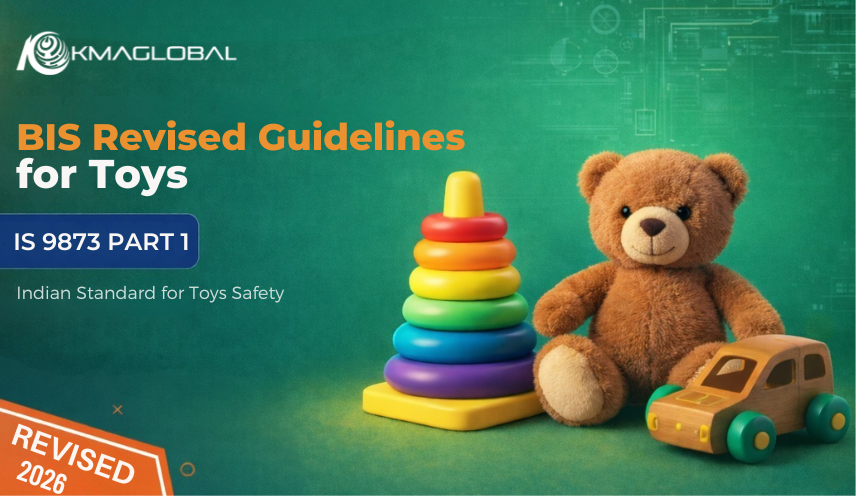
The Bureau of Indian Standards (BIS) has recently released updated implementation guidelines for IS 9873 (Part 1):2025 – Safety of Toys (Mechanical and Physical Properties). This marks an important development for toy manufacturers and licensees operating in India.
The new revision supersedes IS 9873 (Part 1):2019, though manufacturers should note that the earlier version will continue to be recognized until 22 March 2027. Beyond this date, all licenses must operate under the updated standard.
This revision has been undertaken to bring Indian toy safety requirements in line with the latest version of ISO 8124-1, while also strengthening certain provisions related to the mechanical and physical properties of toys.
According to the official circular from the Central Marks Department-2 (CMD-2), the transition from IS 9873 (Part 1):2019 to IS 9873 (Part 1):2025 is now in effect, with 22 March 2027 established as the final withdrawal date for the old standard. The guidelines are applicable immediately, and all Regional Offices, Branch Offices, laboratories, and relevant departments have been instructed to ensure full compliance.
The updated standard introduces several noteworthy modifications:
There has been some simplification in labelling. The previous requirement mandating hazard information in instructions for fixed loops and nooses has been removed, streamlining documentation requirements.
For toys equipped with electrical cables, the placement of warnings has been clarified – they must now appear specifically on the packaging, ensuring clear communication of safety information to consumers.
The standard's scope has been broadened to cover toys designed to be attached to cradles, cots, perambulators, or carriages, as well as toys intended to be suspended over a cot from a wall or ceiling. This expansion addresses a wider range of infant and nursery products.
One of the more significant changes concerns toys with folding mechanisms. These products must now incorporate a safety stop or locking device to prevent unexpected movement or collapse. Importantly, this device must maintain its integrity even during reasonably foreseeable abuse testing. This represents an additional compliance requirement that applicable product manufacturers will need to address.
Electrically driven ride-on toys are now subject to age-specific speed classifications, replacing the previous uniform limit:
Previously, all such toys were restricted to 8 km/h. The revised framework recognizes developmental differences and adjusts safety parameters accordingly.
Several products now require improved warning visibility:
Implementation Guidelines for Licensees
BIS has provided clear direction on the transition process to help licensees navigate the changeover smoothly.
Most licensees will find the transition straightforward:
All licensees must transition to the revised standard by 22 March 2027. After this date, no license will remain valid under IS 9873 (Part 1):2019. Branch Offices have been tasked with ensuring that no licenses continue under the old standard beyond this deadline and must confirm implementation status accordingly.
To verify compliance, surveillance visits are to be scheduled preferably within 30 days of the switchover.
For applications where samples have already been submitted or test reports issued, processing may continue under the old standard. However, applicants who prefer to be evaluated under the revised standard must submit a formal declaration to that effect, along with an undertaking that if the sample fails under the new requirements, a license will not be granted under the old version.
Applications recorded going forward may be processed under either the old or revised standard. However, processing under the old version is permitted only until 21 March 2027, and applicants must declare their commitment to implementing the revised standard by 22 March 2027.
After 22 March 2027, no new licenses will be granted under IS 9873 (Part 1):2019.
For applications involving changes to the scope of an existing license, the same provisions that apply to new applications will be in effect. Processing under the old standard will be permitted only until the implementation date or 22 March 2027, whichever comes first.
The revision of IS 9873 (Part 1):2025 brings important updates to India's toy safety standards. With the 22 March 2027 transition deadline approaching, manufacturers and licensees should prioritize compliance planning to ensure uninterrupted operations under the revised standard. The Bureau of Indian Standards (BIS) has recently released updated implementation guidelines for IS 9873 (Part 1):2025 – Safety of Toys (Mechanical and Physical Properties). This marks an important development for toy manufacturers and licensees operating in India.
The new revision supersedes IS 9873 (Part 1):2019, though manufacturers should note that the earlier version will continue to be recognized until 22 March 2027. Beyond this date, all licenses must operate under the updated standard.
This revision has been undertaken to bring Indian toy safety requirements in line with the latest version of ISO 8124-1, while also strengthening certain provisions related to the mechanical and physical properties of toys.
IS 9873 (Part 1):2025 is the revised Indian Standard issued by the Bureau of Indian Standards (BIS) that specifies mechanical and physical safety requirements for toys in India. It replaces IS 9873 (Part 1):2019.
The earlier version will remain valid until 22 March 2027. After this date, all licences must comply with IS 9873 (Part 1):2025.
For most products, no additional testing is required as many changes are editorial or labelling-related. However, toys with folding mechanisms must demonstrate compliance with the updated safety stop or locking device requirements through testing.
The revised standard introduces age-based speed limits:
Under 3 years: 8 km/h
3 years to under 6 years: 12 km/h
6 years and above: 16 km/h
Yes, but only until 21 March 2027. After 22 March 2027, no new licence will be granted under IS 9873 (Part 1):2019.
About The Author
Jyoti Chauhan is a dedicated Chemical Engineering Professional, delivering value across Regulatory Compliance, Product Conformity, and BIS certification services, with experience in Quality Assurance and Petrochemical & Polymer Res...Read More


Jun 26, 2026
EPR Registration for End-of-Life Vehicles
Jun 24, 2026
EPR Registration for E-Waste Management in India