
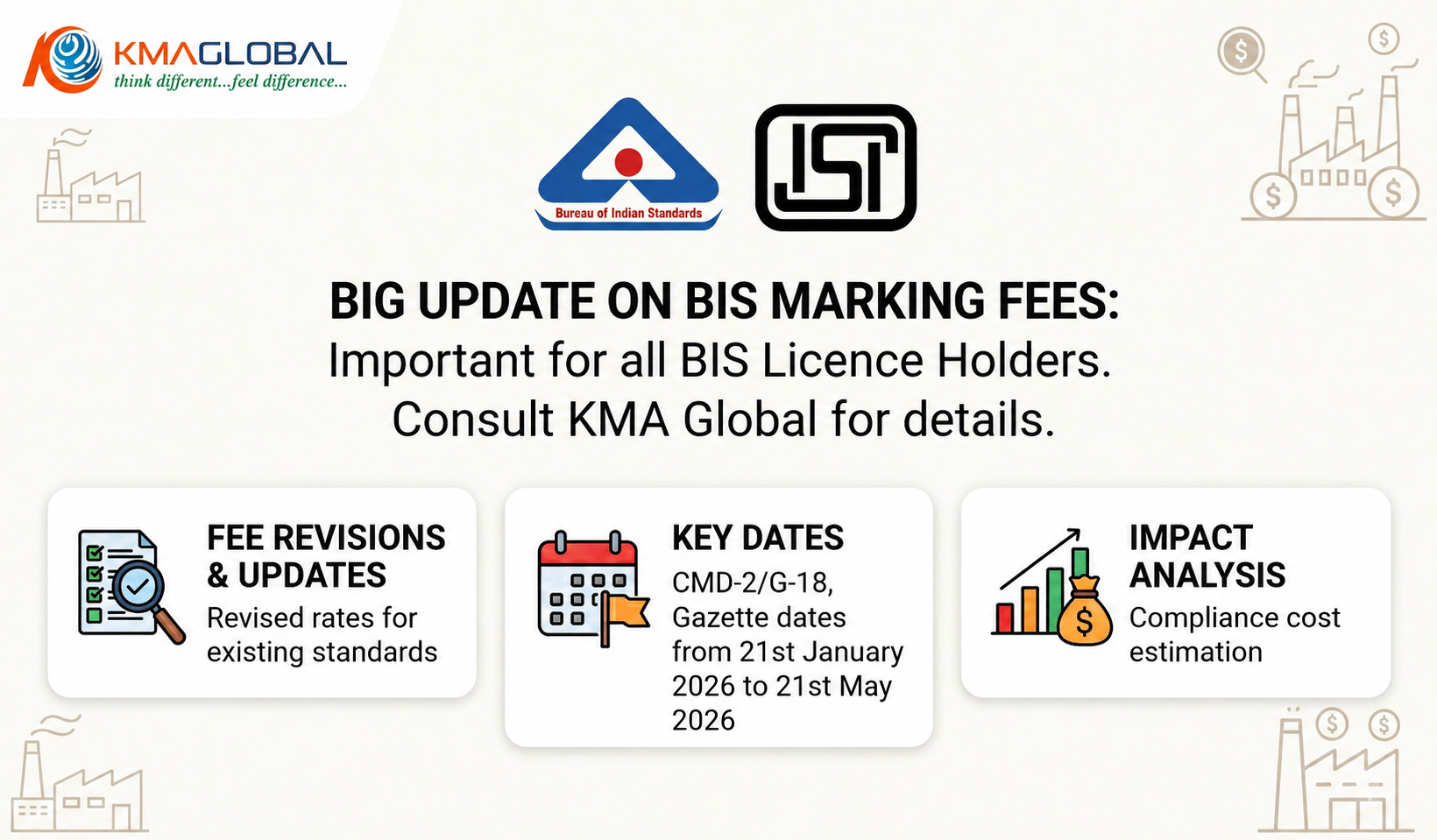
The Bureau of Indian Standards (BIS) has introduced important changes to the Marking Fee Schedule under Scheme-I of the BIS (Conformity Assessment) Regulations, 2018.
The latest revision updates the marking fee structure for several existing Indian Standards and also includes marking fees for newly added standards. It includes significant changes to certification minimum marking fees for Large Scale Enterprises, minimum marking fee for Micro, Small and Medium Enterprises (MSMEs), unit rate and unit of production (such as litre, metric tonne, piece, etc.), minimum marking fee with defined effective dates. These changes are significant for manufacturers, importers and BIS licence holders, as they may impact certification costs, licence renewals and overall compliance planning.
To ensure smooth compliance and avoid any unexpected costs, businesses should review the revised marking fee schedule and determine whether their products are covered under the updated standards.
Notification Details:
Statutory order: CMD-2/G-18 dated 10 June 2026
Gazette Issue Date: 15 June 2026 Gazette
Publish Date: 19 June 2026
Issued By: Bureau of Indian Standards (BIS), Department of Consumer Affairs, Government of India.
BIS Marking Fee is a fee payable by manufacturers holding a valid BIS licence for using ISI Mark on certified products. The fee is generally calculated based on production quantity or other units specified as per the relevant Indian Standard.
It is important to note that the marking fee is separate from the BIS application fee, licence fee, and laboratory testing charges. Instead, it is an ongoing compliance fee that manufacturers must pay to continue using the ISI Mark on their certified products.
Since the marking fee forms an important part of the overall cost of BIS certification, any revision to the fee schedule can directly impact a company's compliance budget and operational costs. Therefore, manufacturers and importers should regularly monitor BIS notifications to stay updated on the latest changes and ensure continued compliance with BIS regulations.
The latest notification brings two major changes to the existing marking fee schedule.
BIS has revised the marking fee structure for the existing Indian Standards by substituting the earlier fee schedule with revised rates. These revisions include updates to the minimum marking fee, unit rate and other applicable fee parameters for various product categories.
Standards such as IS 2028:2024, IS 2029:2004, IS 2997:1964, IS 3650:1981, IS 4003 (Part 1 & Part 2), IS 4123:1982, IS 4508:1992, IS 4509:1992, IS 6149:1998, IS 302 (Part 1):2024/IEC 60335-1:2020 and IS 9202:2020 are among those revised.
Most of these revised fees will become effective one month from the date of notification,
as specified by BIS.
The notification also inserts 43 new entries (Serial Nos. 1760 to 1802) into the Marking
Fee Schedule.
For each newly added Indian Standard, BIS has specified:
The effective dates for these newly introduced standards from 21 January 2026 to 21 May 2026, depending on the respective Indian Standard as mentioned in notification.
Getting a BIS licence is not the end of the compliance process. Manufacturers and importers must also keep track of the latest BIS notifications to ensure continued compliance. The recent revision to the Marking Fee Schedule is an important update that may impact overall cost of BIS certification
and licence renewals.
Keeping up with the latest BIS notifications is essential for every manufacturer and importer. The revised Marking Fee Schedule is an important update that can influence certification costs and ongoing compliance. Reviewing these changes at the right time can help businesses avoid
unnecessary expenses and ensure a hassle-free certification process.
At KMA Global, we are committed to helping businesses stay compliant with the latest BIS requirements. Whether you need support with a new BIS application, licence renewal, marking fee guidance or ongoing compliance, our experts are here to make the process simple and smooth.
About The Author
Jyoti Chauhan is a dedicated Chemical Engineering Professional, delivering value across Regulatory Compliance, Product Conformity, and BIS certification services, with experience in Quality Assurance and Petrochemical & Polymer Res...Read More



Jun 26, 2026
EPR Registration for End-of-Life Vehicles
Jun 24, 2026
EPR Registration for E-Waste Management in India