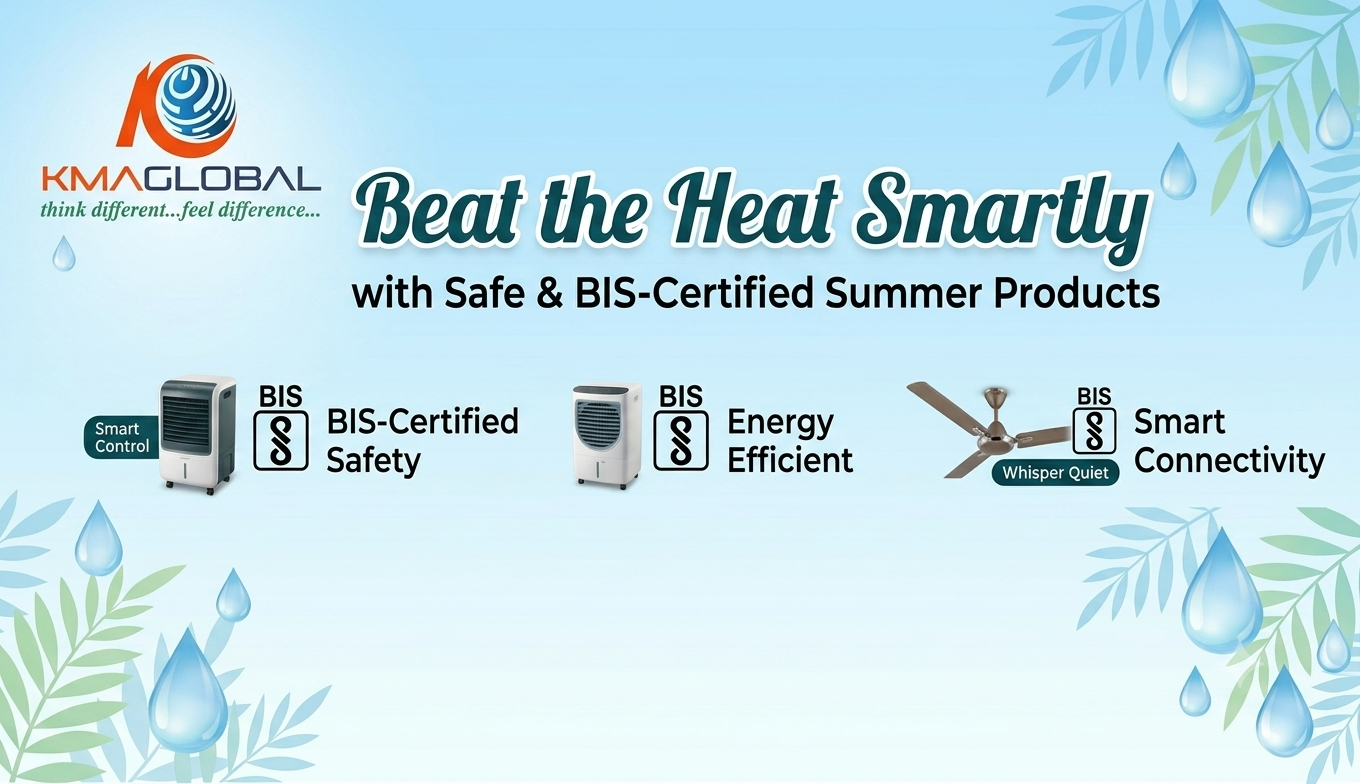
With summer temperatures across India frequently crossing 45 degree and heatwaves becoming more intense every year, staying protected from extreme heat has become more than a matter of comfort, it has become a matter of health and safety.
During the summer season, people depend on various products to manage heat effectively. Water bottles help maintain hydration, refrigerators preserve food quality, air conditioners and air coolers provide cooling comfort, while products like sunscreen and umbrellas protect against direct sunlight.
However, while selecting these essential products, one important factor is often overlooked quality and safety assurance.
A product may look attractive because of its price, design, or features, but poor-quality or non-certified products may create risks such as inefficient performance, reduced durability, health concerns, or even safety hazards.
This makes it important for consumers to make informed choices and for manufacturers to ensure that their products meet applicable quality standards.
The Bureau of Indian Standards (BIS) plays an important role in this area by establishing Indian Standards (IS) that define safety, performance, and quality requirements for various products. BIS certification provides confidence that products have been evaluated against defined standards and are suitable for their intended use.
At KMA GLOBAL , we work closely with manufacturers to help them understand BIS requirements, applicable standards, and compliance procedures. Our experience shows that businesses that focus on quality and compliance from the beginning are better positioned to build customer trust and achieve sustainable growth.
In this blog, we discuss some important summer products, their applicable BIS standards, and the risks associated with choosing non-certified alternatives.
Summer products directly impact daily life, health, and safety. Whether it is a bottle used for drinking water, an appliance used for cooling, or a product used for sun protection, quality cannot be compromised.
BIS certification helps ensure that products meet specific requirements related to:
For manufacturers, BIS compliance is not only about meeting regulatory requirements. It also reflects a commitment towards producing safe and reliable products.
For consumers, purchasing BIS-certified products provides additional confidence regarding quality and performance.
During hot summer months, staying hydrated becomes essential. Water bottles are among the most frequently used products in homes, offices, factories, schools, and while travelling.
Since these bottles are directly connected with drinking water storage, the quality and safety of the material used in manufacturing are extremely important.
BIS-certified water bottles are manufactured using suitable materials and are tested for factors such as:
Stainless steel vacuum bottles are additionally evaluated for thermal performance and structural strength to ensure they maintain temperature effectively while remaining safe for regular use.
Poor-quality bottles may create risks such as material contamination, corrosion, or leaching of metals, especially when exposed to high temperatures.
Bottles manufactured without proper quality checks may affect the safety of stored drinking water. BIS-compliant products undergo testing to ensure that materials remain safe and reliable during usage.
For manufacturers, ensuring compliance helps avoid quality concerns and strengthens customer confidence.
Refrigerators become essential during summer as they help maintain food freshness and prevent spoilage.
Since refrigerators operate continuously for extended periods, their cooling performance, electrical safety, and reliability are critical factors.
IS 17550 (Part 1):2021 – Household Refrigerating Appliances
BIS-certified refrigerators are evaluated for:
Compliance ensures that the appliance performs effectively while reducing potential safety risks.
A non-certified refrigerator may fail to maintain uniform cooling during peak summer conditions, resulting in food spoilage and bacterial growth.
In extreme cases, poor insulation, wiring issues, or substandard components may increase the possibility of electrical failures or fire hazards.
BIS-certified refrigerators undergo performance and safety testing, helping minimise such risks and providing better assurance to consumers.
Air conditioners have become an important solution for maintaining comfortable indoor temperatures during extreme heat conditions.
However, efficient cooling should always be supported by safe operation and reliable performance.
Applicable BIS Standards:
IS 1391 (Part-1):2017 – Room Air Conditioners – Specification Part 1 Unitary Air Conditioners
IS 1391 (Part-2):2018 – Room Air Conditioners – Specification Part 2 Split Air Conditioners
BIS certification ensures that air conditioners meet requirements related to:
For manufacturers, compliance helps ensure that products perform according to defined standards and customer expectations.
An uncertified AC unit may consume excessive electricity while providing inadequate cooling.
Over time, poor-quality components may result in compressor failure, overheating, frequent breakdowns, or electrical hazards.
BIS-certified air conditioners are tested under defined conditions to ensure safer and more reliable operation.
Electric fans remain one of the most accessible cooling solutions in India because they provide effective cooling at an affordable cost.
They are widely used in homes, offices, factories, and commercial spaces.
IS 374:2019 – Electric Ceiling Type Fans
BIS-certified fans are tested for:
These requirements help ensure that fans operate safely and reliably over their service life.
A low-quality fan with poor blade balancing may develop excessive vibration and can create safety concerns.
Weak mechanical structures may increase the risk of damage, while poor-quality wiring may lead to electrical shocks or failures.
BIS-compliant fans undergo testing for strength, durability, and safety, reducing these risks.
While cooling appliances help protect people from rising indoor temperatures, sunscreen products play an important role in protecting skin from direct sunlight and harmful ultraviolet (UV) radiation.
During summer, increased outdoor exposure makes sunscreen an important personal care product for many consumers.
IS 19685:2026 – Sunscreen Cosmetic Products
Sunscreen products should provide reliable protection as claimed by the manufacturer. Product quality, formulation safety, and performance are important factors that directly impact consumer trust.
BIS compliance helps ensure that sunscreen products meet defined requirements related to:
For manufacturers, following applicable standards helps establish credibility and demonstrates responsibility towards customer safety.
A non-standard sunscreen product may claim a high SPF level but fail to provide the expected level of protection against UV exposure.
Poor-quality ingredients or improper formulation may also result in skin irritation or allergic reactions.
Products manufactured according to applicable standards provide better assurance regarding safety and performance.
Umbrellas are one of the simplest and most practical solutions for protecting individuals from direct sunlight during summer.
They are commonly used while travelling, commuting, and during outdoor activities.
IS 2920:1981 – Specification for Umbrellas
A good-quality umbrella should provide protection while being durable enough to withstand environmental conditions.
BIS compliance ensures evaluation of factors such as:
For manufacturers, meeting quality requirements helps reduce product failures and improves customer satisfaction.
A low-quality umbrella with a weak frame may collapse under strong sunlight or wind conditions, leaving the user exposed to heat.
Frequent breakage also results in additional replacement costs for customers.
BIS-compliant umbrellas provide better reliability through evaluation of material strength and overall product quality.
Water coolers are widely used in offices, factories, schools, hospitals, and public facilities to provide chilled drinking water during summer.
Since these products are often used by multiple people, hygiene and safety become extremely important.
IS 1475 (Part 1):2001 – Self-Contained Drinking Water Coolers
BIS-certified water coolers help ensure:
For organisations, selecting compliant water coolers supports a safer workplace environment and helps maintain better hygiene standards.
A non-certified water cooler may develop internal rusting, poor hygiene conditions, or bacterial contamination, affecting the safety of drinking water.
In workplaces and public areas, such issues may increase the risk of health concerns among users.
BIS-compliant water coolers are designed and evaluated to support safer and more reliable operation.
Air coolers remain a popular cooling solution, especially in regions with dry climates where they provide an affordable alternative to air conditioners.
Their energy efficiency and lower operating cost make them suitable for many households and workplaces.
IS 3315:2019 – Evaporative Air Coolers (Desert Coolers)
BIS certification ensures that air coolers are evaluated for:
For manufacturers, compliance helps ensure that products deliver consistent performance and meet customer expectations.
A non-standard air cooler may experience issues such as water leakage, inefficient cooling, poor-quality components, or motor failure within a short period.
Such problems affect customer satisfaction and increase maintenance costs.
BIS-compliant air coolers undergo evaluation to ensure better reliability and longer service life.
While developing and launching summer products, manufacturers often focus on production capacity and market demand. However, compliance planning should be considered an important part of product development.
Some common mistakes include:
Different products have different BIS requirements. Selecting the wrong standard or misunderstanding applicability can result in delays during the certification process.
Manufacturers should identify the applicable Indian Standard before beginning certification activities.
Waiting until products are already available in the market may create regulatory challenges.
Early planning helps manufacturers manage testing, documentation, and certification requirements effectively.
Product testing is a critical part of BIS certification. Manufacturers should ensure that their products meet required safety and performance parameters before applying.
BIS certification should not be viewed only as a compliance obligation. It is also an opportunity to demonstrate quality commitment and build customer trust.
Summer products are not just about comfort; they are directly connected with health, safety, and daily convenience.
For consumers, choosing BIS-certified products helps ensure better confidence in product quality and performance.
For manufacturers, compliance provides an opportunity to demonstrate responsibility, improve credibility, and build stronger relationships with customers.
At KMA GLOBAL, we believe that quality compliance is not only about meeting standards — it is about creating products that customers can trust.
Need assistance with BIS certification, QCO applicability, or product compliance? Connect with KMA GLOBAL experts today.
Stay cool. Stay protected. Stay ahead with BIS-certified products.
BIS-certified products provide confidence regarding safety, quality, and performance. They are evaluated against applicable Indian Standards, helping consumers make informed purchasing decisions.
BIS certification requirements depend on the specific product category and applicable regulations. Some products require mandatory certification, while others may have voluntary certification provisions.
Manufacturers should verify the applicable requirements for their product category.
Non-certified products may create risks related to:
The specific risk depends on the type of product.
Several commonly used summer products are covered under BIS standards, including:
Each product category has specific applicable standards and requirements.
Manufacturers should first identify their product category and check the applicable Indian Standard. Professional guidance can help businesses understand compliance requirements and avoid delays.
BIS certification helps manufacturers:
Yes. KMA GLOBAL provides support for BIS certification requirements, including standard identification, documentation guidance, compliance consultation, and certification process assistance.
About The Author
Megha Solanki is a Food Technologist with over 2 years of experience in regulatory compliance and conformity assessment with hands-on exposure to BIS certification procedures, food safety regulations and statutory compliance requiremen...Read More


Jun 26, 2026
EPR Registration for End-of-Life Vehicles
Jun 24, 2026
EPR Registration for E-Waste Management in India