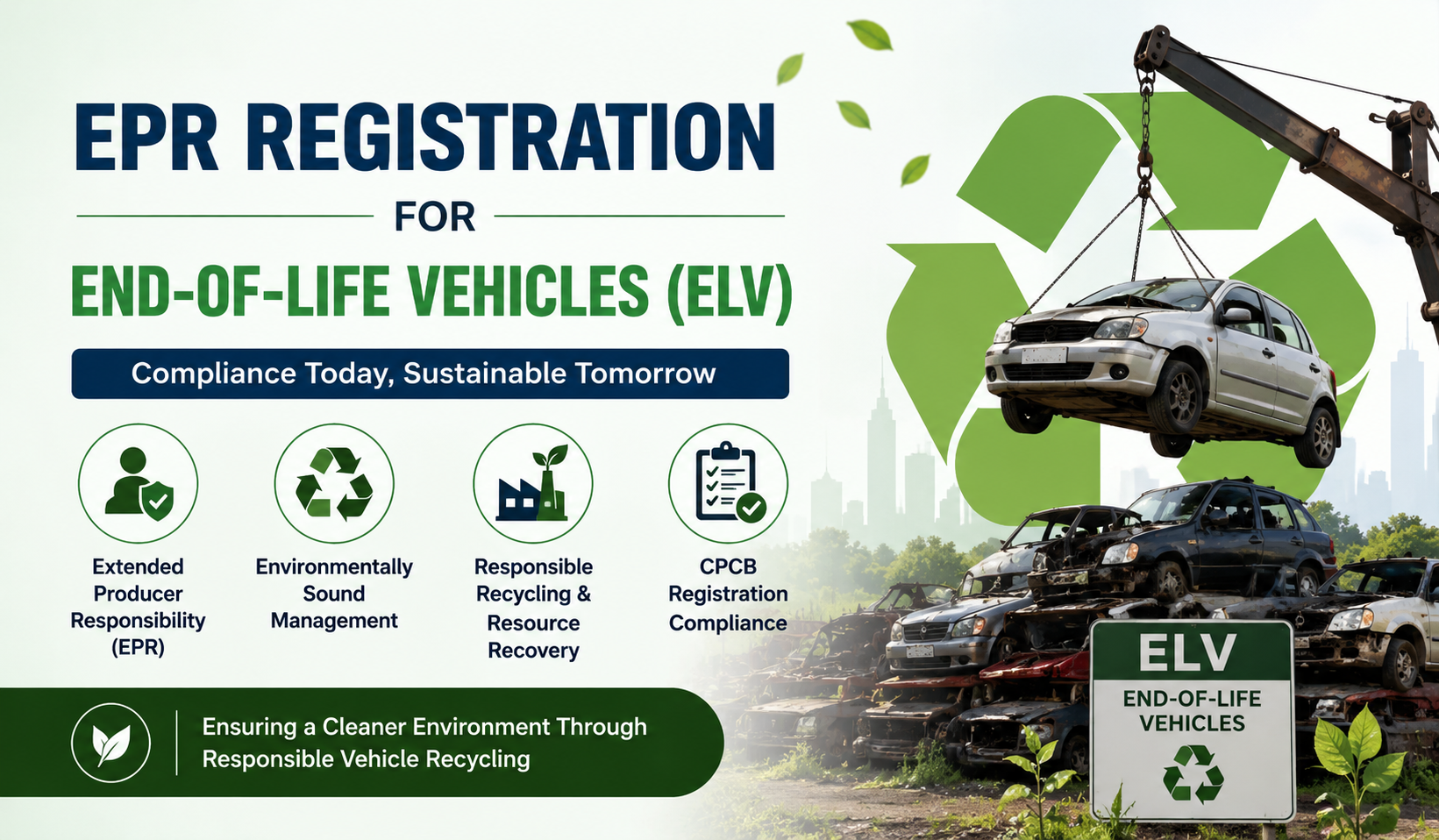
End-of-Life Vehicle (ELV) is a vehicle that has approach the end of its useful life and scrape of all type of vehicle like two wheeler, three wheeler, four wheeler, scrape vehicle, commercial vehicle and long vehicle is no long time suitable for use, damage, wear, or failure to meet regulatory requirements. ELVs require environmentally sound dismantling, recycling, and disposal to minimize environmental impact and recover valuable material.
This is responsibility of a Producer/RVSF for scrapping of the End-of-Life vehicle in environmentally sound manner. In EPR make sure that old vehicle are properly scrape, vehicle recycle, pollution is control under EPR rules, the responsibility of managing this vehicle does not end with the owner manufacturers and other stakeholders are also involved.
Goals of ELV Management
Promote environmentally sound manner disposal of vehicles, recover, reuse and recycle material, reduce waste pollution.
Extended Producer Responsibility (EPR) for ELV (End of Life Vehicle) applies to all engaged entity like producer, importer in supply chain who introduce scrap vehicle into the Indian market. Compliance is mandatory under the environment protection (End-of-Life Vehicles) Rules, 2025. The following unit Producer/RVSF, importer of vehicle, manufacture, commercial vehicle, electric vehicle or assembly and sale of vehicles under its own brand must responsible for ELV EPR Registration/Certification.
The following entities shall register for EPR registration certificate for ELV (End of Life Vehicle) on the centralized EPR authorization portal developed by CPCB.
Producer
RVSF (Registered Vehicle Scrape Facility)
If a company selling thousands of vehicles every year. After 10–15 years, these vehicles become scrap. If they are illegally, pollution increases. EPR authorization ensure vehicles go to authorized scrapping centre and properly scrap of vehicle and its part safely.
One of the most important of EPR for ELV is its large applicability. Entities with direct EPR Obligation. Vehicle manufacturer, vehicle importer, producers selling vehicles under their brand, entities placing vehicles into the Indian market.
Different from Producers the rules also apply to.
I) Registered vehicle owner
II) Bulk consumer (having more then 100 vehicle) section 2 of motor vehicle act 1988
III) Register Vehicle Scraping Facility (RVSF)
IV) Collection centre
The conduct of End-of-Life Vehicles (ELVs) in India is governed by environment protection (End-of-Life Vehicles) Rules, 2025 aim to ensuring the safe collection, dismantling, recycling, and disposal of vehicles that have reached the end of life. The framework is based on the principle of Extended Producer Responsibility (EPR), under which vehicle manufacturers and producers are responsible for the environmentally sound management of vehicles at the end of their lifecycle there are some legal frameworks.
The primary legal basis for ELV management in India is the Environment (Protection) Act, 1986. The ELV rule has been notified under this act to regulate the environmentally sound handling and recycle of end-of-life vehicles.
The environment protection (End-of-Life Vehicles) Rules, 2025 were notified by the MoEFCC (Ministry of Environment, Forest and Climate Change) on 6 January 2025 and come into force on 1 April 2025. These rules found a framework for ELV collection, scrapping, recycling, and EPR compliance.
The Motor Vehicles Act, 1988 provides the legal base for vehicle registration, condition of requirements of vehicle, de-registration, and identification of vehicles that qualify as End-of-Life Vehicles.
In India Vehicle Scrapping Policy promotes the replacement of old and unfit fit less vehicles through authorized scrapping facilities and condition testing, supporting resource recovery and environmental protection.
Producer and importer and all automobile industry shall have extended producer responsibility to meet the achieve target and recycle of steel recover from end-of-life vehicle in country provide by EPR guideline.
India has introduced Extended Producer Responsibility (EPR) for End-of-Life Vehicles (ELV) under the environment protection rule (End-of-Life Vehicles) Rules, 2025. Under this framework, vehicle manufacturers and importers are responsible for registration ensuring environmentally sound manner. Its registration mandatory for Producer, importer, scrapping, recycling, and disposal of vehicles at the end of their life:-
Account creation on the CPCB (Central Pollution Control Board) has introduced a portal for ELV EPR.
Before filling out the application form, make sure you have a copy of the all-relevant documents in pdf, jpg, file formats.
The application process begins registration on the centralized portal to obtain login credentials, followed by application filling.
Submit business plan provide company, vehicle like manufactured assemble and sale of vehicles and brand owner, and operational details.
The Producer shall provide the following details in case: -
Producer shall upload CA Certificate for each FY in proof of information.
Annual turnover (in crores) declaration the total revenue from the sale of vehicles during the financial year.
The applicant shall pay the application fees for registration. The fees shall be paid online using the payment gateway on the portal.
Once the application submitted by producer, CPCB will follow the below Procedure/RVSF for processing the application for grant of registration.
The producer, importer shall pay the registration fees as per the details given below along with the application for registration.
| Sr. No. | Average Annual turns over | Registration Fees (INR) |
|---|---|---|
| 1 | ≤ 10 Cr | 25,000 |
| 2 | >10 Cr To ≤ 50 Cr | 50,000 |
| 3 | >50 Cr To ≤ 250 Cr | 200,000 |
| 4 | >250 Cr To ≤ 1000 Cr | 50,00,00 |
| 5 | >1000 Cr | 10,00,000 |
The fees shall be paid online through the payment gateway integrated in the portal.
50% of application fees is to be paid as Annual Processing Fees at time of filling returns.
The said rules also assign responsibilities to registered vehicle scrapping facilities. accordingly, RVSFs are required to register on the centralized ELVs portal and generate EPR certificates based on the quantity of steel recovered from ELVs. These certificates shall be purchased by producers for fulfil of their EPR obligations for the respective financial year.
The RVSF shall pay the registration fees as per the details given below along with the application for registration.
| Sr. No. | Scrapping Capacity of the RVSF (No. of ELVs/Year) | Registration Fees (INR) |
|---|---|---|
| 1 | ≤ 6,000 | 25,000 |
| 2 | > 6,000 to ≤ 15,000 | 50,000 |
| 3 | > 15,000 to ≤ 30,000 | 75,000 |
| 4 | > 30,000 | 1,00,000 |
The fees shall be paid online through the payment gateway integrated in the portal.
50% of application fees is to be paid as Annual Processing Fee at time of filling returns.
The EPR Registration process for End-of-Life Vehicles (ELV) generally takes 15 to 45 working days, depending on set of document read and approval by the our expert concern team. The process includes document preparation, registration on the CPCB ELV portal, submission of the EPR application, verification by CPCB, and issue of the registration certificate.
After getting Registration/Certificate done by producer follow compliance. It's valid for lifetime it is cancel or withdraw by authority. There are no prescribed for renewal requirement under the environment and protection (End of Life Vehicle) rule 2025.This entity must continuous comply with
EPR registration and certification for End-of-Life Vehicles (ELVs) ensure legal compliance, and environmental protection by CPCB responsibility from the vehicle owner to the automobile manufacturer or importer.
Legal compliance & Risk avoidance: EPR certificate insure that producer, importer, brand owner is fully compily with CPCB guideline. It help business avoid legal action, penalty or vehicle bans due to non-compliance with Environment and protection (End of Life Vehicle) rule 2025.
Promote Recycling Process: The ELV framework promote recycling, dismantling, and recovery of material from scrape vehicle.
Environmental Protection: Proper scrapping and recycling of vehicle and help reduce pollution disposal of critical material and support environment safe.
Access to EPR Certificate Mechanism: Producers can fulfil their obligations through EPR certificates generated by authorized Registered Vehicle Scrapping Facilities (RVSFs), creating a clear compliance mechanism.
EPR Registration for End-of-Life Vehicles (ELVs) helps ensure that old and scrap vehicles are collected, dismantled, recycled, and disposed of in a proper and environmentally safe manner. It is a mandatory requirement for vehicle manufacturers, importers, and Registered Vehicle Scrapping Facilities (RVSFs) under the Environment Protection (End-of-Life Vehicles) Rules, 2025. By obtaining EPR registration, businesses can comply with legal requirements, support recycling activities, and reduce environmental pollution. Proper compliance also helps in the efficient management of vehicle waste and promotes responsible use of resources.
About The Author
Arun Pratap Singh is specialization of Mechanical Engineer with over three years of experience in corrugated box and 1.5 year experience in Wind Renewable Energy .
Professional Experience
Read More


Jun 26, 2026
EPR Registration for End-of-Life Vehicles
Jun 24, 2026
EPR Registration for E-Waste Management in India