Tables and desks are essential furniture items used extensively in offices, homes, and public spaces. Given their functional importance, these products must demonstrate adequate stability, strength, and durability during normal use as well as under conditions of reasonably foreseeable misuse.
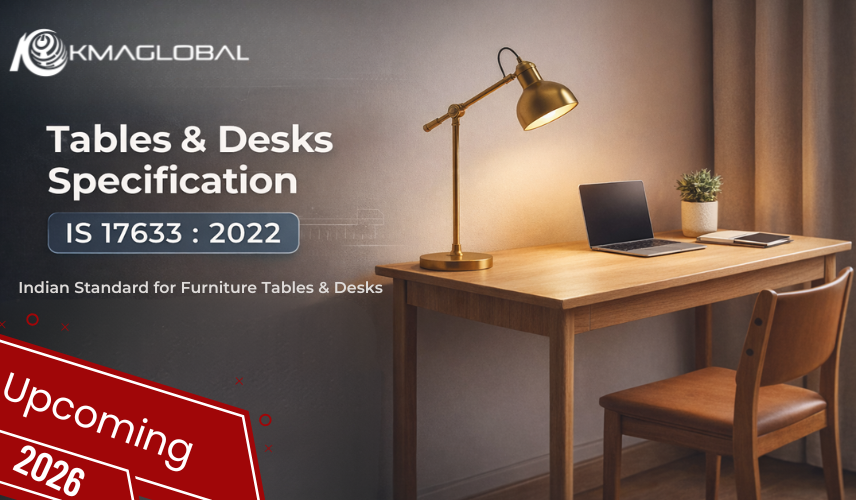
To establish uniform performance and safety benchmarks, the Bureau of Indian Standards (BIS) issued IS 17633:2022 – Tables and Desks — Specification.
This Indian Standard consolidates and supersedes several earlier standards that addressed different types of tables and desks. It introduces comprehensive requirements focused on strength, stability, durability, and safety, while accounting for modern materials, construction methods, and usage patterns.
The standard applies to:
IS 17633:2022 establishes performance and safety requirements for tables and desks used by adults in seated, sit–stand, or standing positions. The standard covers both office and domestic applications, including tables that incorporate glass components.
The testing procedures prescribed under this standard are designed to simulate normal functional use as well as misuse that can reasonably be expected to occur. These tests assess performance independent of material type or manufacturing process, ensuring uniform evaluation across different designs and constructions.
The standard applies to completely manufactured or fabricated tables and desks as well as ready-to-assemble units, which are evaluated after assembly.
IS 17633:2022 specifies requirements relating to the performance and safety of tables and desks, specifically covering strength, stability, and durability.
These requirements apply to furniture intended for adult users and designed for use in office environments such as worktables, desks, meeting tables, and pantry tables, as well as domestic environments including dining tables, study tables, side tables, and similar furniture.
The standard does not include test methods for storage elements and does not assess long-term aging or material degradation beyond defined durability tests.
As per IS 17633:2022, tables and desks shall comply with the declared design or model of the manufacturer. Exposed surfaces, edges, and protruding parts shall be free from burrs, sharp edges, stains, or unsafe finishes. There shall be no exposed open-ended tubes or unfinished edges on accessible parts. These requirements ensure user safety during regular interaction with the furniture.
The dimensions of tables and desks shall conform to IS 3663, which specifies dimensions for office tables and chairs. Alternative dimensions may be adopted based on mutual agreement between the manufacturer and purchaser or specific design requirements, provided functionality and performance are not compromised.
Rigid surface finishes of tables and desks shall meet the minimum performance ratings specified in IS 17637. Surface performance tests include resistance to mechanical damage, pencil hardness, wet and dry heat, marking by cold liquids, marking by cold oils and fats, and adhesive performance. These tests ensure that surface finishes can withstand everyday usage conditions.
IS 17633:2022 specifies detailed safety testing covering stability, strength, and durability.
Stability Tests
Stability tests assess the ability of tables and desks to remain upright and safe without overturning when subjected to specified vertical and horizontal loads.
Stability under vertical load involves applying vertical loads near the edge of the tabletop at locations most likely to cause overturning. Test conditions vary based on table height, table category (office or domestic), surface area of the tabletop, and the presence of extension elements. Height-adjustable tables are tested at the most adverse height position, and tables with extension elements are tested in both extended and un-extended configurations. The table shall not overturn during or after load application.
Stability with extension elements open requires loading each extension element as specified in the standard, followed by application of a vertical load at a defined distance from the edge at the most critical location. The table shall remain stable with extension elements open.
Stability under horizontal load is evaluated by applying a horizontal force perpendicular to the tabletop edge at critical locations. Storage components remain unloaded and closed during testing. Tables fitted with castors are tested in their least stable orientation, while taller tables and tables with affixed screens or storage units are tested at multiple locations. Limited tilting is permitted, but the table shall not overturn or disengage.
Tables shall not overturn when subjected to the specified stability test forces.
Strength tests evaluate the capacity of tables and desks to withstand vertical static loads, horizontal static forces, and occasional heavy loads. Deflection limits, joint integrity, and structural performance are assessed to ensure adequate strength under defined loading conditions.
Durability tests simulate long-term repeated use to ensure that tables and desks maintain structural integrity, stability, and safe performance over time.
Durability under vertical force involves applying repeated vertical loads near the tabletop edge at locations most likely to cause failure. These tests are conducted for thousands of load cycles depending on the table type and application. The table shall not show structural damage, excessive deformation, or loss of functionality.
Durability of height-adjustment mechanisms, where applicable, subjects height-adjustable tables to repeated full up-and-down movement cycles under specified loading conditions. Loads are applied at different positions across the tabletop. The mechanism shall operate smoothly without failure, excessive wear, or loss of function.
Durability under horizontal force evaluates resistance to wobbling, loosening, or structural degradation by applying repeated horizontal forces alternately in opposite directions at the tabletop level.
Durability of tables with castors, where applicable, is assessed by moving the table back and forth over a test surface with obstacles. This verifies the durability of castors, fixings, and the overall table structure.
Each table or desk conforming to IS 17633:2022 shall be legibly and permanently marked with the manufacturer’s name or trademark, date of manufacture, design or model number, and batch or lot number. For ready-to-assemble furniture, assembly instructions shall be provided in printed or digital form.
Products conforming to this standard may be certified under BIS conformity assessment schemes and marked with the BIS Standard Mark as per applicable regulations.
IS 17633:2022 establishes a unified and comprehensive framework for evaluating the performance, safety, and durability of tables and desks used in office and domestic environments. By defining standardized test methods and acceptance criteria, the standard ensures consistent assessment of furniture products under real-world usage conditions.
Manufacturers, purchasers, and testing bodies can rely on IS 17633:2022 as a definitive national reference for evaluating tables and desks against recognized Indian safety and performance benchmarks.
IS 17633:2022 applies to tables and desks used by adults in office and domestic environments, including seated, sit-stand, and standing applications.
Yes. The requirements apply to ready-to-assemble tables after they have been assembled.
Yes. The standard includes specific impact and safety tests for tables with glass in their construction.
Yes. Dimensions are referenced from IS 3663, with flexibility for agreed or design-based dimensions.
The standard states that products conforming to IS 17633:2022 may be certified under BIS conformity assessment schemes and marked with the Standard Mark.
About The Author
Digital Marketing Executive
...Read More




Jun 26, 2026
EPR Registration for End-of-Life Vehicles
Jun 24, 2026
EPR Registration for E-Waste Management in India