Introduction
Vacuum cleaners and water suction cleaning appliances have become common in Indian households and commercial spaces, offering convenience, efficiency, and improved hygiene. However, appliances that combine electrical energy, rotating motors, heating elements, and possible exposure to moisture inherently carry risks such as electrical shock, overheating, fire, and mechanical failure.
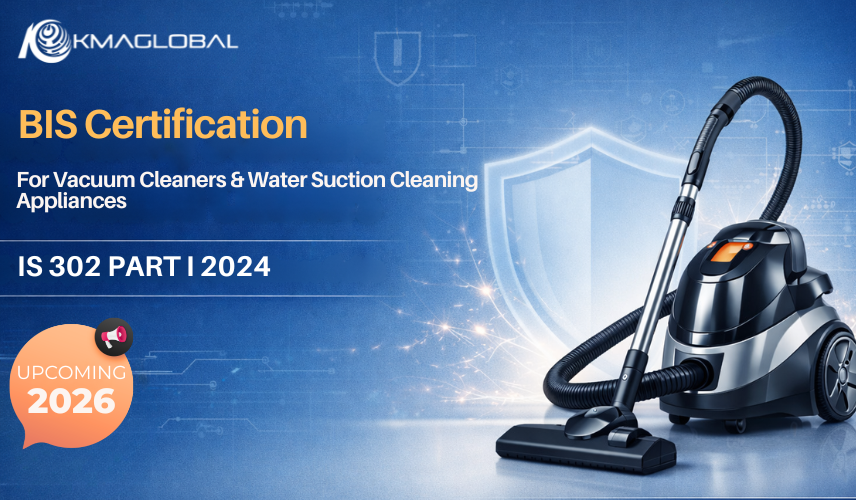
To ensure uniform safety and accountability, the Bureau of Indian Standards (BIS) adopted IS 302 (Part 1): 2024, which is technically identical to IEC 60335-1:2020. This standard establishes the general safety requirements that household and similar-use electrical appliances must meet before being placed in the market. Vacuum cleaners and water suction cleaning appliances fall within its scope.
This article explains what IS 302 (Part 1): 2024 requires and what it means for manufacturers, importers, and quality professionals in this product category.
Overview of IS 302 (Part 1): 2024
At its core, IS 302 (Part 1): 2024 is a general safety standard which means it lays down the foundational requirements that apply across a broad range of household electrical products. It is not specific to vacuum cleaners alone; rather, it forms the baseline on which appliance-specific Part 2 standards are built.
The standard covers appliances with the following electrical ratings:
- Rated voltage up to 250 V for single-phase appliances
- Rated voltage up to 480 V for other appliances, including DC-operated units & applicable for battery operated appliances
Who Does This Standard Apply To?
IS 302 (Part 1) applies to household and similar electrical appliances intended for use by ordinary members of the public not trained technicians or engineers. This includes appliances used in domestic settings, as well as those deployed in shops, light industrial environments, and farms.
The standard explicitly excludes the following categories:
- Appliances designed exclusively for industrial purposes
- Medical electrical equipment
- Information technology equipment
- Motor-operated handheld tools
- Appliances intended for use in corrosive or explosive atmospheres
- Transportable motor-operated electric tools
- Audio/video, information and communication technology equipment
- Electric motor-operated hand-held tools, transportable tools and lawn and garden machinery
Vacuum cleaners and water suction cleaning appliances, being firmly in the household appliance category, must comply with both Part 1 (general requirements) and the applicable Part 2 standard that addresses their specific product characteristics.
General Safety Requirements: The Foundation
IS 302 (Part 1) requires that appliances be constructed so that they operate safely during normal use and under reasonably foreseeable misuse.
To achieve this, the standard sets requirements across several interconnected areas:
- Protection against access to live parts
- Protection against electric shock
- Insulation coordination, clearances, and creepage distances
- Protective earthing arrangements
- Leakage current limits
- Electric strength testing
- Resistance to moisture
- Resistance to heat and fire
- Mechanical strength and structural stability
How Appliances Are Classified
Classification under IS 302 (Part 1) is not merely administrative; it determines which specific construction and testing requirements apply to a given product. Appliances are classified based on the following parameters:
Protection against electric shock:
Class I (basic insulation plus protective earth)
- Class II (double or reinforced insulation, no earth required)
- Class III (operation on safety extra-low voltage)
- Degree of protection provided by enclosures (relevant for moisture and dust ingress)
- Method of supply mains-operated or battery-operated
- Mode of operation
For vacuum cleaners specifically, the classification chosen by the manufacturer at the design stage has significant downstream implications it shapes the insulation philosophy, the earthing requirements, and ultimately, the testing protocol the product must survive.
Protection Against Access to Live Parts
Appliances shall be constructed and enclosed so that there is adequate protection against accidental contact with live parts. Compliance is checked by inspection and by the tests of 8.1.1 to 8.1.3, as applicable, considering 8.1.4 and 8.1.5.
Class II appliances and class II constructions shall be constructed and enclosed so that there is adequate protection against accidental contact with basic insulation and metal parts separated from live parts by basic insulation only. It shall only be possible to touch parts which are separated from live parts by double insulation or reinforced insulation. Compliance is checked by inspection and by applying the test probes specified in 8.1.1 in accordance with the conditions specified in 8.1.1.
For a battery-operated appliance where the battery circuit has a functional earth connection or a supply connection, it shall only be possible to touch parts within a battery compartment where:
- In class I appliances, class 0I appliances and class II appliances, they are separated from live parts by double insulation or reinforced insulation
- In class 0 appliances, they are separated from live parts by basic insulation
- The battery compartment is of class III construction
However, if the limits in 8.1.4 are exceeded, then basic insulation is required in addition to supply at SELV. Compliance is checked by inspection and by applying the test probes specified in 8.1.1 in accordance with the conditions specified in 8.1.1.
Heating
Appliances and their surroundings shall not attain excessive temperatures in normal use. Compliance is checked by determining the temperature rise of the various parts under the conditions specified in 11.2 to 11.7.
Hand-held appliances are held in their normal position of use. Appliances with pins for insertion into socket-outlets are plugged into an appropriate wall-mounted socket-outlet. Built-in appliances are installed in accordance with the instructions.
Heating appliances are operated under normal operation and at 1.15 times rated power input.
Motor-operated appliances are operated under normal operation and supplied with the most unfavourable voltage between 0.94 times and 1.06 times the rated voltage.
Combined appliances are operated under normal operation and supplied with the most unfavourable voltage between 0.94 times and 1.06 times the rated voltage.
Leakage Current and Electric Strength
The leakage current of the appliance shall not be excessive and its electric strength shall be adequate. Compliance is checked by the tests of 16.2 and 16.3. Protective impedance is disconnected from live parts before carrying out the tests. The tests are carried out on the appliance at room temperature and not connected to the supply mains.
An AC test voltage is applied between live parts and:
- Accessible metal parts intended to be connected to protective earth, for class I appliances and class 0I appliances
- Metal foil having an area not exceeding 20 cm × 10 cm which is in contact with accessible surfaces of insulating material and metal parts not intended to be connected to protective earth, for class 0 appliances, class II appliances, class II constructions and class III appliances
Immediately after the test of 16.2, the insulation is subjected to a voltage having a frequency of 50 Hz or 60 Hz for 1 minute in accordance with IEC 61180. The values of the test voltage for different types of insulation are given in Table 7. Accessible parts of insulating material are covered with metal foil. Care is to be taken that the metal foil is placed so that no flashover occurs at the edges of the insulation.
Mechanical Strength and Stability
Appliances shall have adequate mechanical strength and be constructed to withstand such rough handling that may be expected in normal use. Compliance is checked by applying blows to the appliance in accordance with test Ehb of IEC 60068-2-75, the spring hammer test. The appliance is rigidly supported and three blows, having an impact energy of 0.5 J, are applied to every point of the enclosure that is likely to be weak.
Accessible parts of solid insulation shall have sufficient strength to prevent penetration by sharp implements. Compliance is checked by subjecting the insulation to the specified test unless the thickness of supplementary insulation is at least 1 mm and that of reinforced insulation is at least 2 mm.
Appliances with pins for insertion into socket-outlets where the plug part is capable of rotation shall be provided with a mechanical stop to prevent rotation beyond which stress to electrical connections and internal wiring may occur. The mechanical stop shall have adequate mechanical strength and be constructed to withstand such rough handling that may be expected in normal use.
Moisture Resistance
The enclosure of the appliance shall provide the degree of protection against moisture in accordance with the classification of the appliance.
- Appliances subject to spillage of liquid in normal use shall be constructed so that such spillage does not affect their electrical insulation.
- Appliances shall be proof against humid conditions that may occur in normal use.
Construction Requirements
If the appliance is marked with the first numeral of the IP system or any of the additional letters of the IP system, the relevant requirements of IEC 60529:1989 including its amendments shall be fulfilled. Compliance is checked by the relevant tests.
For stationary appliances, means shall be provided to ensure disconnection from the supply mains. Such means shall be one of the following:
- A supply cord fitted with a plug
- A switch providing all-pole disconnection
- A statement in the instructions that a disconnection incorporated in the fixed wiring is to be provided
- An appliance inlet
Single-pole switches and single-pole protective devices that disconnect heating elements from the supply mains in single-phase, permanently connected class 0I appliances and class I appliances shall be connected to the line conductor.
Appliances with pins for insertion into socket-outlets shall not impose undue strain on these socket-outlets. The means for retaining the pins shall withstand the forces to which the pins are likely to be subjected in normal use.
Conclusion
IS 302 (Part 1): 2024 is a demanding standard deliberately so. It was built on the recognition that household electrical appliances, precisely because they are used by non-specialists in unpredictable conditions, must be held to rigorous and verifiable safety requirements.
For vacuum cleaners and water suction cleaning appliances, compliance with Part 1 establishes the foundational safety framework. The appliance-specific provisions in the relevant Part 2 standard then build on this foundation to address the characteristics and use scenarios of each product type.
For manufacturers and importers, meeting this standard is not simply about regulatory compliance. It is about producing appliances that people can use in their homes with genuine confidence products that perform reliably under normal conditions and fail safely when things go wrong.In a market where consumer expectations around product safety are rising and BIS enforcement is increasingly active, IS 302 (Part 1): 2024 is the standard that serious manufacturers build to not because they must, but because it reflects the right engineering philosophy.