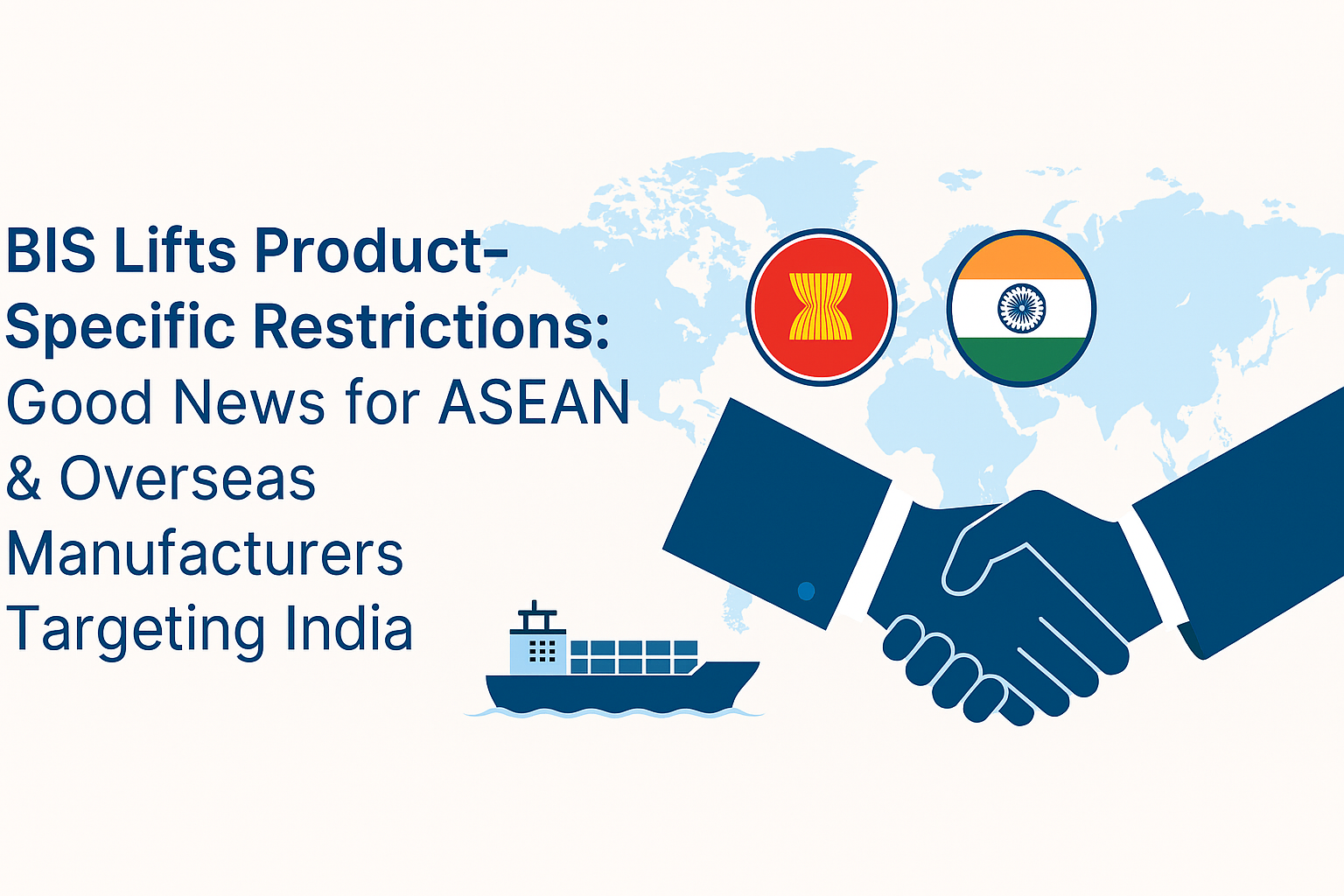
India’s regulatory framework for product certification and imports continues to evolve, especially for overseas manufacturers supplying goods to the Indian market. One topic that has gained attention across the industry is whether India may, in the future, lift product specific restrictions for ASEAN overseas manufacturers in India.
At present, no official notification confirms such a change. However, discussions around trade facilitation, supply chain diversification and ease of doing business have increased industry awareness on this subject.
At KMA GLOBAL, we are closely monitoring all developments related to this matter through Ministry notifications and Government orders published in the Official Gazette.
Understanding the Role of BIS and the Government
The Bureau of Indian Standards (BIS) is responsible for implementing and enforcing product standards in India. BIS ensures that products under mandatory certification schemes comply with applicable Indian Standards before being manufactured, imported or sold.
It is important to clarify that BIS does not independently lift or remove product specific restrictions. Any relaxation, exemption or removal of restrictions can only be done through:
Therefore, any decision to lift product specific restrictions for ASEAN overseas manufacturers in India would originate from the concerned Ministry, not directly from BIS.
Why ASEAN Manufacturers Are Watching This Space
ASEAN countries are key trading partners for India across sectors such as electronics, chemicals, steel, consumer goods and industrial components. Overseas manufacturers exporting to India must comply with mandatory BIS certification requirements depending on the product category.
Industry stakeholders are observing whether future government policies may:
Such developments, if officially notified, could significantly influence India market entry strategies for ASEAN manufacturers.
KMA GLOBAL’s Monitoring and Advisory Approach
At KMA GLOBAL, we are actively tracking:
Our focus is to ensure that overseas manufacturers receive accurate, verified and timely guidance, based strictly on official government communications.
What Overseas Manufacturers Should Do Today
Until any formal notification is issued, current compliance requirements remain in force. Overseas manufacturers should:
Conclusion
As of now, there is no official confirmation that product specific restrictions have been lifted for ASEAN overseas manufacturers in India. Any such change can only be implemented through a Ministry or Government order published in the Official Gazette.
KMA GLOBAL will continue to keep a close watch on policy developments related to lifts product specific restrictions for ASEAN overseas manufacturers India and will share authenticated updates once officially announced. Until then, overseas manufacturers are advised to remain compliant with existing BIS regulations and stay informed through reliable regulatory channels.
The lifting of product‑specific restrictions means that manufacturers from countries like Vietnam, Thailand, Indonesia, Turkey, and others no longer face additional compliance barriers while applying for BIS certification. Applications will now follow standard procedures and timelines without extra scrutiny.
The update particularly benefits manufacturers in ASEAN countries—such as Vietnam, Thailand, and Indonesia—as well as other affected regions like Turkey. These exporters can now access the Indian market with faster certification and fewer delays.
Yes. BIS has started clearing applications that were previously on hold due to these product‑specific restrictions. This means pending cases will move ahead smoothly and new applications will follow the usual timeline.
While the announcement removes product‑specific restrictions, the requirement for BIS certification remains based on the Indian Standards applicable to each product. So, manufacturers must still comply with the relevant BIS standards for their category.
With reduced processing delays, overseas manufacturers can now plan product launches, shipments, and market expansion with greater confidence. Faster certification means quicker access to India’s growing market and improved supply chain predictability.
Yes, Indian importers should experience smoother procurement cycles because foreign suppliers will now obtain certifications faster. This can improve stock availability and reduce supply disruptions.
Yes, BIS certification remains mandatory for all products listed under the Mandatory Certification Schemes (CRS, ISI, or FMCS). The update only removes extra restrictions—it does not remove the requirement for certification itself.
Manufacturers can proceed with documentation, product testing, and application submission as per normal BIS procedures. Since restrictions are removed, they can expect clearer timelines and quicker approvals compared to earlier months.
A consulting partner helps manufacturers navigate technical standards, testing protocols, documentation requirements, and BIS portal submissions—ensuring that the process remains timely and error‑free, especially now that approvals are faster.
Yes. This move aligns with India’s focus on simplifying compliance for global manufacturers. It supports trade growth, strengthens import quality, and makes India a more attractive destination for international businesses.
About The Author
Ashwini Kumar is an Electronics Engineer with over nine years of professional experience in Regulatory Affairs, as well as the Solar and Lighting industries, with a strong record of working in regulated and technology-driven environmen...Read More


Jun 26, 2026
EPR Registration for End-of-Life Vehicles
Jun 24, 2026
EPR Registration for E-Waste Management in India