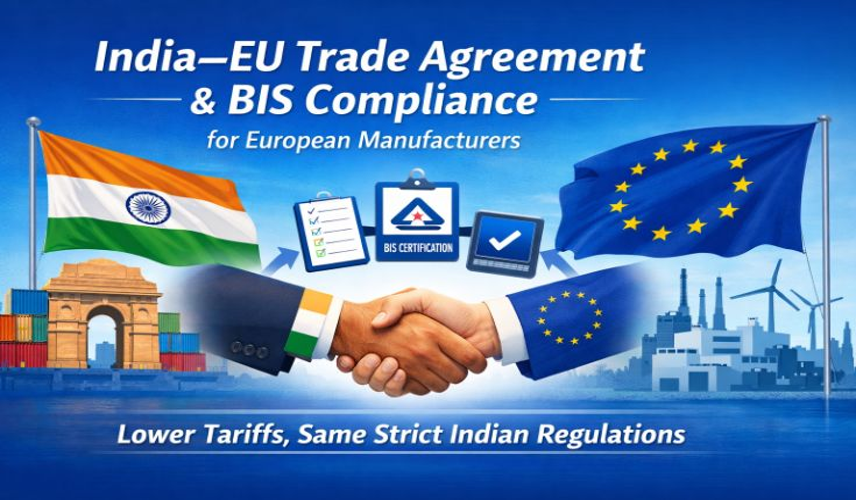
Introduction: Why everyone is talking about the India–EU trade deal
The proposed India–European Union (EU) Trade Agreement has generated strong interest across global manufacturing and export communities. For European manufacturers, India represents one of the fastest-growing large markets, with rising demand for electronics, machinery, industrial components, consumer goods, and regulated products.
The trade agreement is expected to reduce tariffs, improve market access, and simplify certain trade procedures. However, one critical point often misunderstood is this:
Lower customs duties do not mean fewer regulatory or compliance requirements in India
For many products, Indian technical regulations especially BIS certification will continue to apply strictly. In fact, as more EU companies plan entry into India, the importance of structured compliance planning will only increase.
What the India–EU trade agreement actually changes (in simple business language)
At a high level, the India–EU trade agreement aims to:
For European manufacturers, this can mean:
However, the agreement does not override Indian domestic laws, especially those related to:
Tariffs vs. regulations: Lower duties do not mean less compliance
A common assumption is that trade agreements “relax” regulations. In reality:
Even after the India–EU trade agreement:
In short:
Trade agreements support market access, but compliance enables market entry.
A quick primer on BIS: What it is and why it matters for imports into India
The Bureau of Indian Standards (BIS) is India’s national standards body. It regulates product quality and safety across multiple sectors.
Why BIS is critical for European manufacturers
Many products cannot be imported, sold, or distributed in India without a valid BIS licence, including:
Common BIS schemes affecting EU exporters
Shipment delays at Indian ports
Why European manufacturers will need stronger India-focused compliance support
As the trade agreement encourages more EU companies to explore India:
Quality Control Orders will expand to more product categories
For most European manufacturers, Indian compliance is not identical to EU CE marking and cannot be treated as a simple extension of EU conformity.
Key compliance pain points for EU manufacturers
European companies entering India commonly face challenges such as:
Without local expertise, these issues often lead to:
How Indian regulatory partners like KMA GLOBAL can help
As an India-based regulatory and compliance service provider, we support European manufacturers with end-to-end India compliance, including:
Our typical support process
Example scenarios: EU electronics manufacturer entering India under CRS
A European electronics brand plans to export power adapters and control units to India.
Key requirements:
Without CRS:
With structured compliance support:
EU machinery or components manufacturer facing new Quality Control Orders
An EU industrial components manufacturer finds that its product category has been newly notified under an Indian Quality Control Order (QCO).
Challenges include:
Early engagement with an Indian compliance partner helps avoid:
Practical tips for EU manufacturers planning India market entry
If you are considering India under the India–EU trade framework:
Compliance planning should run in parallel with commercial strategy, not after it.
Turning trade opportunity into compliant market entry
The India–EU trade agreement opens new doors for European manufacturers but compliance remains the key to unlocking them.
With increasing regulatory enforcement and expanding BIS coverage, European companies that plan compliance early will move faster, safer, and with greater confidence in the Indian market.
Get a free initial compliance assessment
If you are a European manufacturer evaluating India as a target market, we invite you to contact us for a free initial compliance assessment for your product line.
We help you understand:
The India–EU trade agreement is a proposed free trade arrangement aimed at improving trade and investment between India and the European Union. It focuses on reducing tariffs, improving market access, and strengthening economic cooperation, but it does not replace or override Indian product regulations.
No. The India–EU trade agreement does not remove BIS certification or other Indian regulatory requirements. Products covered under mandatory BIS standards must still obtain BIS registration, ISI marking, or CRS certification before being imported or sold in India.
Yes. European manufacturers exporting regulated products to India must obtain the applicable BIS licence for imports into India, regardless of tariff reductions under the trade agreement.
The Bureau of Indian Standards (BIS) is India’s national standards authority. BIS ensures product safety, quality, and consumer protection. For many product categories, BIS approval is legally mandatory before import, sale, or distribution in India.
No. CE marking or EU conformity assessment is not sufficient for India. Indian authorities require compliance with Indian Standards, which may differ from EU norms. BIS certification is evaluated separately.
If BIS certification is skipped:
Shipments may be detained or seized at customs
Products can be ordered for re-export
Financial penalties may be imposed
Brand reputation and distributor relationships may be affected
Common product categories include:
Electronics and IT products (CRS)
Electrical appliances
Industrial machinery and components
Automotive parts
Construction materials
Consumer goods under Quality Control Orders
CRS (Compulsory Registration Scheme) is a BIS scheme applicable mainly to electronics and IT products. Under CRS, products must be tested in BIS-recognised Indian laboratories and registered before import into India.
Quality Control Orders are government notifications that make BIS certification mandatory for specific products. QCOs are expanding rapidly, especially in industrial and manufacturing sectors, and apply equally to Indian and foreign manufacturers.
As the trade agreement encourages more European companies to enter India, regulatory enforcement is expected to increase. BIS compliance will play a key role in ensuring fair competition, safety, and quality in the Indian market.
Timelines vary by product and scheme:
CRS registration: typically 4–6 weeks
ISI marking and QCO compliance: 3–6 months or more
Early planning significantly reduces delays
Yes. Foreign manufacturers must appoint an Authorised Indian Representative (AIR) to liaise with BIS and Indian authorities and to manage compliance responsibilities in India.
Indian regulatory and compliance consultants assist with:
Identifying applicable BIS requirements
Aligning EU products with Indian standards
Coordinating testing in Indian laboratories
Preparing documentation and applications
Managing regulator interactions and inspections
No. BIS certification involves:
Ongoing surveillance
Periodic renewals
Compliance with changes in standards or QCOs
Post-certification support is essential for continued compliance.
European manufacturers should:
Start BIS and regulatory assessment early
Map compliance requirements product-wise
Budget time for testing and certification
Work with experienced Indian compliance partners
Integrate compliance planning with market entry strategy
About The Author
Ashwini Kumar is an Electronics Engineer with over nine years of professional experience in Regulatory Affairs, as well as the Solar and Lighting industries, with a strong record of working in regulated and technology-driven environmen...Read More



Jun 26, 2026
EPR Registration for End-of-Life Vehicles
Jun 24, 2026
EPR Registration for E-Waste Management in India