
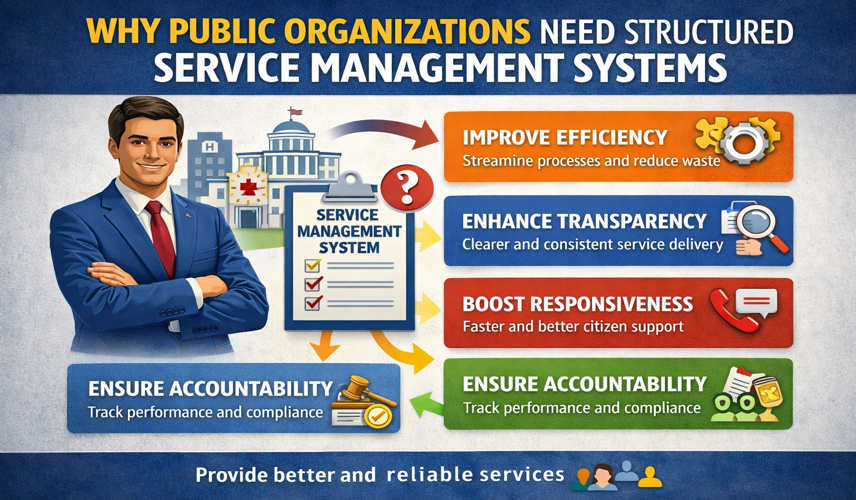
Public service organizations play an important role in providing various services to citizens, businesses, and other stakeholders. The quality of these services directly affects public confidence, operational efficiency, and overall governance. For this reason, it is important that services are delivered in a consistent, transparent, and well-organized manner.
A Service Quality Management System (SQMS) provides a structured approach for managing service delivery. In India, this concept is addressed in IS 15700, an Indian Standard issued by the Bureau of Indian Standards (BIS). The standard specifies requirements for establishing and maintaining a system aimed at improving the quality of services provided by public service organizations.
A Service Quality Management System (SQMS) is a management framework that helps organizations plan, control, and improve the delivery of services to citizens or customers.
The system focuses on managing service delivery through clearly defined procedures, monitoring mechanisms, and periodic review of performance. Through such an approach, organizations can deliver services in a a systematic and reliable manner while responding to the expectations of service users.
Unlike informal service practices, SQMS emphasizes the need for structured management processes where service delivery activities are documented, monitored, and reviewed on a regular basis.
Under IS 15700, a Service Quality Management System is intended primarily for public service organizations that provide services directly to citizens or other stakeholders.
The standard provides a framework for managing service processes so that services are delivered in accordance with defined commitments, service standards, and organizational policies. It also highlights the importance of monitoring the management system that supports these services.
In this way, the focus of SQMS is not only on the service itself but also on the management practices that ensure the service is delivered effectively and consistently.
The core idea behind SQMS is the systematic management of service delivery. This involves establishing clear processes and responsibilities so that services can be delivered in a controlled and consistent manner.
Some key elements of this approach include:
By following such a structured approach, organizations can maintain consistency in service delivery and respond more effectively to the needs of service users.
An important aspect of SQMS is the focus on citizens or service users. Public services exist to meet the needs of the public, and therefore the management system should support services that are accessible, transparent, and responsive.
Organizations implementing SQMS are encouraged to consider factors such as:
Attention to these aspects helps organizations understand how services are experienced by users and how those services can be improved.
The Service Quality Management System (SQMS) framework under IS 15700, issued by the Bureau of Indian Standards, is primarily applicable to public service organizations that provide services directly to citizens, businesses, or other stakeholders.
The standard is intended for organizations where the quality, timeliness, and transparency of service delivery are important. SQMS can be applied to various government departments and public agencies that deliver administrative, regulatory, and public utility services.
Examples of such services include:
By adopting the SQMS framework, such organizations can establish a structured and systematic approach for managing service delivery, monitoring service performance, and maintaining consistency in the quality of services provided to the public.
The central idea behind SQMS is that service quality should be managed through a structured system rather than informal practices. This means that responsibilities, procedures, and monitoring mechanisms are clearly defined within the organization.
By implementing SQMS, organizations can ensure that service delivery is planned, controlled, and periodically reviewed. This approach helps maintain consistency in services and supports the identification of areas where improvements may be required.
Service Quality Management System (SQMS) provides a structured framework for managing the delivery of services in public service organizations. As described in IS 15700, the system focuses on establishing defined processes, monitoring service performance, and maintaining consistent service delivery practices.
By adopting such a management system, public service organizations can develop a more organized and transparent approach to service delivery, thereby supporting improved interaction between institutions and the people they serve.
About The Author
Technical professional in management system standards training support, quality documentation, and coordination. Brings a strong analytical background with expertise in structured reporting, compliance-focused content, and training ope...Read More

Jun 26, 2026
EPR Registration for End-of-Life Vehicles
Jun 24, 2026
EPR Registration for E-Waste Management in India