Introduction to the Indian Standard - Low Heat Portland Cement (IS 12600:1989)
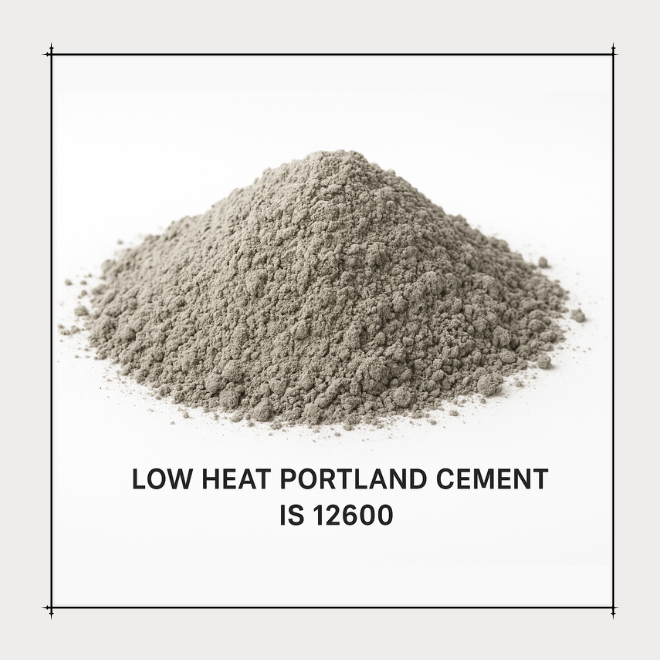
The specifications, chemical Composition, and physical characteristics of Low Heat Portland Cement (LHPC) are outlined in the Indian Standard IS 12600:1989. To prevent thermal cracking in large concrete structures or to lower the amount of heat produced during hydration this type of cement is specifically designed for that.
Applications where temperature controlling is critical during the curing, such as on dams, retaining walls, raft foundations, and bridge piers, Low Heat Portland Cement are best suited for these. To achieve a slower rate of strength gain with less heat evolution, it is made possible by when the amount of dicalcium silicate (C₂S) is increased and the amount of tricalcium aluminate (C₃A) decreased.
Why BIS Certification is Needed for Low heat Portland cement
According to the Ministry of Commerce & Cement Industry's (Quality Control Orders), Low Heat Portland Cement in India must obtain a BIS Certification as per IS 12600:1989. This certification guarantees that the product satisfies specified performance, durability, and safety requirements.
BIS certification is mandatory for the following reasons:
• Regulatory compliance: In accordance to the Cement Quality Control Order, BIS-certified product (cement) can be produced, distributed, or imported into India only.
• Quality assurance: BIS makes sure that the LHPC meets specifications for strength and chemical composition, that ensures the excellent performance and safety in heat-stressed environments.
• Market credibility: From boosting the consumer trust, the ISI mark makes it possible and also to participate in government initiatives, public tenders, and major infrastructure contracts.
• Production consistency: Manufacturers are required to maintain consistency for quality control and by routine testing and inspections conducted by Bureau of Indian Standards.
To learn about the detailed BIS Certification Process and Documents Required for obtaining a BIS Licence for IS 12600,
click here
For Foreign Manufacturers
For Domestic Manufacturers
Which BIS Scheme is Applicable for Low heat Portland cement?
For BIS certification, Low Heat Portland Cement is covered Scheme-I (ISI Mark Scheme). While for foreign manufacturers who are exporting to India must apply through the Foreign Manufacturers Certification Scheme (FMCS), both manufacturers must obtain a BIS license to use the Standard Mark.
Testing and Labelling Requirements for Low heat Portland cement
According to IS 12600:1989 and the relevant Product Manual published by BIS, cement must fulfil the following testing requirements:
• Fineness (Blaine technique)
• Initial and final setting times
• Soundness using the Le Chatelier technique
• Compressive strength after 3, 7, and 28 days
• Hydration heat (7 and 28 days)
• Chemical composition (insoluble residue, MgO, SO₃ content, ignition loss, etc.)
Requirements for Packaging and Marking:
The ISI Mark/Standard mark, batch number, manufacturer's name, and the words "Low Heat Portland Cement, must all be visible on each cement bag. Only when the product satisfies every BIS quality requirement can carry the mark on its products.