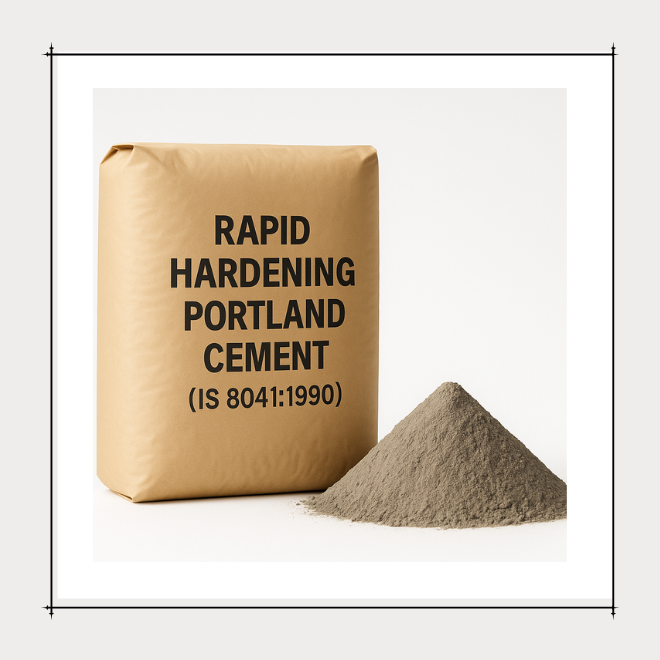
BIS Certification for Rapid Hardening Portland Cement - IS 8041:1990
Introduction to IS 8041 (Rapid Hardening Portland Cement)
Rapid Hardening Portland Cement (RHPC), also known as the High-Early Strength Portland Cement, is designed to attain the high compressive strength within a shorter curing period as compared to Ordinary Portland Cement. This cement is widely used in fast-track construction, road pavements, precast concrete units and many other areas where formwork must be removed early.
Indian Standard IS 8041:1990 specifies about the chemical composition, physical properties, manufacturing process, testing requirements, packing and marking guidelines for Rapid Hardening Portland Cement. As according to the latest regulatory requirements, only BIS certified “rapid hardening cement” can be manufactured, sold or imported in India.
Purpose & Why Certification Is Mandatory
Under multiple government instruments like BIS Act 2016, BIS Rules 2018 and the Cement (Quality Control Order) notified by DPIIT, stated that all the manufacturers of Rapid Hardening Portland Cement are legally required BIS certification (ISI Mark) for their product before commercial sale.
BIS Certification is Mandatory to:
Manufacturing Requirements as per IS 8041
As per IS 8041, Rapid Hardening Portland Cement must be produced by:
After burning, no other material can be added except gypsum, water, or permitted additives.
BIS Certification Process to Obtain BIS ISI Mark for IS 8041 or for any other product:
For Foreign Manufacturers
For Domestic Manufacturers
Documents Required for obtaining a BIS Licence as per IS 8041 (Rapid Hardening Portland Cement)
Administrative Documents
Technical & Quality Documents
Commercial Documents
Fees payment proofs
Applicable BIS certification Scheme
|
Scheme Type |
Applicable For |
Mark Used |
|---|---|---|
|
Scheme-I (ISI Mark) |
Indian Manufacturers |
ISI mark |
|
FMCS (Foreign Manufacturers Certification Scheme) |
Foreign Exporters |
ISI mark |
✔ CRS (Electronics), Scheme X (Recycling), and others do not apply to cement.
Testing & Quality Requirements (Mandatory Tests)
Each batch must comply with IS 8041 through the testing as per BIS methods. The primary tests include:
Chemical Tests
Physical Tests
A BIS-approved in-house laboratory or testing facility is mandatory for certification and for production control.
Labelling, Packing & Marking Requirements
According to IS 8041: